* This article originally appeared on the Huffington Post UK on 14/3/17.
Cuba is a country that has long been associated with rum, cocktails and cigars. It is spiritual home of classic cocktails such as the daiquiri and mojito and boasts some of the world’s most iconic bars in the capital, Havana. But there are now new places popping up to challenge the older and more traditional establishments. On a recent visit to Havana, I went to check a mix of the old and new – here are my five favourites.
Showing posts with label cuba. Show all posts
Monday, March 20, 2017
Monday, October 10, 2011
Our visit to Cuba > Part 2
At the end of August and start of September, Whisky For Everyone went in to a three week hibernation. This was our longest period of non-blogging since we began nearly three and a half years ago. The reason was simple - we went on holiday! Here, we have decided to share a few observations, experiences and photos from our time away. Part 1 can be found by clicking here, but here we go with Part 2 ...
Something which you cannot help but notice as you travel around Cuba is evidence of the Revolution. Even though this happened in the late 1950s, it is like it happened last year. You can't get away from it. There are revolutionary slogans painted everywhere by the government as a constant reminder of it - even in the middle of nowhere there will have been a concrete slab erected and something painted on it. Images of leader Fidel Castro and especially his right hand man Che Guevara are equally everywhere. This can be seen in its most celebratory form in the massive Plaza de la Revolución in Havana, where the iconic Guevara adorns the side of an eight floor government building.
Our next port of call was the town of Trinidad on the southern coast. This is a Spanish colonial town that is a UNESCO World Heritage Site. It was built around the sugar cane industry and the neighbouring valley - the Valle de los Ingenios - was once the heart of the Cuban sugar industry. The town is lovely and photogenic with a relaxed feel. Here, unlike the rest of Cuba (with the exception of parts of Old Havana), you don't have to work at seeing the 'stunning colonial architecture' that the guide books shout about. It is laid on a plate for you and the busloads of tourists that arrive everyday. Everywhere else in the country you have to visually peel back 30-40 years of decay and neglect to begin to see the charm.
One highlight of the stay in Trinidad was a train journey into the Valle de los Ingenios. The valley was once one of the main production areas for sugar cane in Cuba and was home to over 70 sugar mills. Then it fell on hard times, largely due to its location - the imposing Escambray mountains form a natural barrier with the rest of the island. We took a ride on one of original sugar cane trains, which was a classic old steam locomotive pulling two rickety wooden carriages. It was all very touristy but it got us out in to more stunning landscape, in a similar way to our horse riding in Viñales. The train was built in 1902 in Philadelphia and it chugged its way slowly through the valley to the small town of Iznaga. Iznaga was formerly the site of the largest sugar cane plantation in Cuba and the town is dominated by the Torre Iznaga - a 45 metre high tower used for observing the slaves working in the fields.
We then moved to the north coast of the island and the tourist haven of Varadero. This 'town' is a dreadful eyesore of a place with wall-to-wall all-inclusive hotels as far as the eye can see. However, the reason it is there is because of its fantastic location - it sits on a spit of land which has the Caribbean's longest beach on one side and a lagoon on the other. It was the one place that we didn't go for culture - we went for gratuitous beach, pool and sunbathing action. The beach was idyllic, with snow white sand and azure blue sea that lived up to our vision of a Caribbean beach. After a few days of all-you-can-drink Piña Coladas, we headed back to Havana for the last part of our trip.
This time we stayed in Old Havana, which is a part of the city that has been renovated to its former glory by the Castro Government. Here you can see the colourful buildings, painted in yellow, green and blue, that you see in the guide books. However, you don't have to walk far to see the 'real' Havana that the Government are less keen for tourists to see. The people were friendly enough but the obvious poverty meant that, as before, they wanted to extract any pesos they could from you and weren't scared to use their creativity to do so ...
Whilst in Havana one of the highlights was a visit to the Havana Club rum museum. This is housed in one of the old company buildings, which sits in the bedraggled dock area of the city. Here we were taken on a personal guided tour of the museum, having arrived just before a busload of Canadian tourists. Our tour guide (Yeny) showed us various artifacts from early rum making and gave us a basic history of the sugar plantations, slavery and the birth of the Cuban rum industry. Without doubt the best part was the explanation of how rum is made, which is something we were unfamiliar with. Please watch our video below, where Yeny took us through the different stages of production. It was interesting to find out how the process differs from that of making whisky. We finished with a couple of shots of rum in the gorgeous wooden Havana Club bar.
So is Cuba the gorgeous time-warp of a place that the guide books portray? Yes, in places. In other places it is a rundown and poor, with the famous architecture and classic cars being patched up and shadows of their former selves. The landscapes that we traveled through were stunning and idyllic in many locations, especially the serene Valle de Viñales. Are the people the 'friendliest in the world', as our book put it? No - we met some lovely people especially outside of the main touristy spots, but in the touristy spots it felt that you were running the gauntlet on most occasions as you were constantly pestered and bombarded with questions in the street. Will we go back again? Probably not. Did we enjoy our visit? Mostly yes, sometimes no. Are we glad that we went? Definitely yes.
Something which you cannot help but notice as you travel around Cuba is evidence of the Revolution. Even though this happened in the late 1950s, it is like it happened last year. You can't get away from it. There are revolutionary slogans painted everywhere by the government as a constant reminder of it - even in the middle of nowhere there will have been a concrete slab erected and something painted on it. Images of leader Fidel Castro and especially his right hand man Che Guevara are equally everywhere. This can be seen in its most celebratory form in the massive Plaza de la Revolución in Havana, where the iconic Guevara adorns the side of an eight floor government building.
![]() |
| Che Guevara - Plaza de la Revolución, Havana |
![]() |
| The church in Trinidad |
![]() |
| Train 1590 at Iznaga station |
This time we stayed in Old Havana, which is a part of the city that has been renovated to its former glory by the Castro Government. Here you can see the colourful buildings, painted in yellow, green and blue, that you see in the guide books. However, you don't have to walk far to see the 'real' Havana that the Government are less keen for tourists to see. The people were friendly enough but the obvious poverty meant that, as before, they wanted to extract any pesos they could from you and weren't scared to use their creativity to do so ...
![]() |
| The Havana Club bar |
So is Cuba the gorgeous time-warp of a place that the guide books portray? Yes, in places. In other places it is a rundown and poor, with the famous architecture and classic cars being patched up and shadows of their former selves. The landscapes that we traveled through were stunning and idyllic in many locations, especially the serene Valle de Viñales. Are the people the 'friendliest in the world', as our book put it? No - we met some lovely people especially outside of the main touristy spots, but in the touristy spots it felt that you were running the gauntlet on most occasions as you were constantly pestered and bombarded with questions in the street. Will we go back again? Probably not. Did we enjoy our visit? Mostly yes, sometimes no. Are we glad that we went? Definitely yes.
Tuesday, October 4, 2011
Our visit to Cuba > Part 1
At the end of August and start of September, Whisky For Everyone went in to a three week hibernation. This was our longest period of non-blogging since we began nearly three and a half years ago. The reason was simple - we went on holiday! Here, we have decided to share a few observations, experiences and photos from our time away.
We had decided to go to Cuba - a country portrayed as being in a 1960s time-warp and living the socialist ideal where everyone is equal. Part of our fascination was to see this country before Fidel Castro dies. It is believed that once he goes, then Cuba may change for ever. So is it all cigars, mojitos and classic American cars as the holiday brochures and guide books would lead you to believe? We were about to find out ...
After our nine hour flight from London, we arrived in Havana - the largest city in the Caribbean. It's hot. Not English Summer hot (15°C when we left!) but a balmy 35°C with 85% humidity. We are to stay in the iconic Hotel Nacional, which was once frequented by Winston Churchill and Ernest Hemingway. This immense building has just celebrated its 80th anniversary and sits overlooking the famous eight mile long Malecón and the sea. The place looks impressive but has a distinct air of faded grandeur about it.
You do not have to spend long in Havana before you meet some of the 'friendly locals' that the guide books tell you about. This 'friendliness' manifests itself in the form of numerous ways to part you with your capitalist cash! We lost count of how many times we were asked if we wanted a taxi or a guided tour of the city on a rickshaw-bike thing or to buy cigars? This turned out to be true for virtually the entire trip, not just Havana. Everyone seems to own a taxi, bike or know someone who works in a cigar factory!
Cuba is famous for its cigars and tobacco growing, so despite not being cigar aficionados or big smokers we decided to visit a cigar making factory while in Havana. Having said that, we have enjoyed the occasional cigar with a good dram of whisky! The factory in question was Partagas, which is housed in a gorgeous Spanish colonial building in the heart of the city. Here we had a guided tour which showed us the production process and the chance to see the torcedores, the highly skilled craftsmen and women who hand roll the cigars, at work (torcedoras for the ladies!). It was as hot as hell in there and fascinating to see. For further information on cigar production - check out our post on Cigars & Whisky.
After a few days exploring Havana, we moved to the small farming town of Viñales in the western Pinar del Rio province. This is where some of the best tobacco in the world is grown. To get there, we boarded a surprisingly modern bus (by far the most modern vehicle we had seen to date) and traveled along the national AutoPista - the worst, most brain-jangling major highway in the world. It's a shocker. It's a road so bad that Cubans don't actually use it. All we saw were tourist buses, tourist hire cars and the occasional horse. The road was built in the 1980s with Soviet cash (which then ran out, so it remains half completed!) and clearly hasn't been maintained since then.
The pace in Viñales was very different to Havana. The surrounding landscape and valley - the Valle de Viñales - is gorgeous and is dominated by the majestic and distinctively shaped mountains, called mogotes. Locals grow a multitude of crops in the fertile valley soil, including tobacco, pineapples, rice and sweetcorn. One day, we went on horse riding trek into the valley. This was the only form of transport that can get deep into the valley and the scenery was stunning and tranquil. The highlight was visiting a tobacco warehouse where they receive leaves from the farmers, sort them and ferment them for up to four years, before sending them to factories such as the Partagas one in Havana.
Click the video clip below to see some of the sights and sounds of this warehouse. Later, we had a meeting with a tobacco farmer and smoked a cigar with him, which he hand rolled for us using leaves from his plantation. Sadly we couldn't see any plants, as we were between growing seasons.
Our journey around Cuba will continue in Part 2 shortly.
We had decided to go to Cuba - a country portrayed as being in a 1960s time-warp and living the socialist ideal where everyone is equal. Part of our fascination was to see this country before Fidel Castro dies. It is believed that once he goes, then Cuba may change for ever. So is it all cigars, mojitos and classic American cars as the holiday brochures and guide books would lead you to believe? We were about to find out ...
![]() |
| A taxi in Havana |
You do not have to spend long in Havana before you meet some of the 'friendly locals' that the guide books tell you about. This 'friendliness' manifests itself in the form of numerous ways to part you with your capitalist cash! We lost count of how many times we were asked if we wanted a taxi or a guided tour of the city on a rickshaw-bike thing or to buy cigars? This turned out to be true for virtually the entire trip, not just Havana. Everyone seems to own a taxi, bike or know someone who works in a cigar factory!
![]() |
| The Partagas cigar factory |
After a few days exploring Havana, we moved to the small farming town of Viñales in the western Pinar del Rio province. This is where some of the best tobacco in the world is grown. To get there, we boarded a surprisingly modern bus (by far the most modern vehicle we had seen to date) and traveled along the national AutoPista - the worst, most brain-jangling major highway in the world. It's a shocker. It's a road so bad that Cubans don't actually use it. All we saw were tourist buses, tourist hire cars and the occasional horse. The road was built in the 1980s with Soviet cash (which then ran out, so it remains half completed!) and clearly hasn't been maintained since then.
![]() |
| Valle de Viñales |
Click the video clip below to see some of the sights and sounds of this warehouse. Later, we had a meeting with a tobacco farmer and smoked a cigar with him, which he hand rolled for us using leaves from his plantation. Sadly we couldn't see any plants, as we were between growing seasons.
Our journey around Cuba will continue in Part 2 shortly.
Tuesday, March 9, 2010
Explain about ...Cigars and whisky
A marriage made in heaven?The association between whisky and cigars has a long history and is one that remains strong. Many people enjoy a dram of whisky with a cigar as an evening pastime, as part of a celebration or just for enjoyment. We recently had the opportunity to learn more about cigars at a beginner’s class operated by Hunters & Frankau, the UK’s leading independent importer for Cuban cigars.
Hunters & Frankau have been trading since 1790 and you can learn more about them and their range at www.cigars.co.uk. As we knew nothing about cigars before the class, we decided to write this post to show some basics that were learnt and will help us understand more. We hope this helps if you find yourselves in a similar position to us! We will concentrate on the Cuban cigar industry, although tobacco is grown and many of the same practices are followed in other countries around the world. Here goes ... it's a long one!
Why Cuba?Cuba is regarded by many as the spiritual home of cigar production and is renowned for producing some of the world’s finest cigars. It is home to some of the world’s best known cigar brands such as Romeo y Julieta, Montechristo and Cohiba. Cuba is a Caribbean island that lies between the southern tip of Florida, USA and the island of Jamaica. Cuba’s climate and fertile soil gives it ideal conditions for growing tobacco plants and the island has a rich heritage connected with tobacco. When Christopher Columbus landed on Cuba in 1492, he was greeted by the natives and was offered cohibas (the Spanish word for cigar) and tobacco plants as gifts. It is believed that the cohibas formed part of the island’s ceremonial festivals. Columbus cannot have realised the immense effect that his ‘discovery’ would have on the world!
The tobacco plantTobacco plants have large flat leaves and in the cigar industry these leaves are graded. The plant is split in to three sections – the leaves at the base are called volado, the leaves in the centre are seco and the leaves at the top are ligero. Each type of leaf has its own properties and is used in different parts of the cigar and cigar making process. It is believed that all of the native tobacco plants on Cuba are directly descended from the plants that were around when Columbus arrived over 500 years ago. The Cuban Black Tobacco (Latin name tabaco negro cubano) was a wild plant before it was first farmed and cultivated in the 16th century. It is grown in defined regions (similar to the ‘denomination of origin’ system in wine – ie: Champagne, Chianti, Rioja etc), and each has an exceptional soil and micro-climate to produce high quality tobacco. These are called the Vegas Finas de Primera and there are four –
*Vuelta Abajo (on the far western tip of Cuba and regarded as producing the best tobacco in the world)
*Semi Vuelta (still on the western peninsula but further inland)
*Partido (further east and the closest region to Havana, Cuba’s capital)
*Vuelta Arriba (this is split in to two areas – one in Central Cuba called Remedios, which is the oldest growing area in Cuba and one on the eastern peninsula called Oriente).
Different types of cigars
There are two methods of making a cigar – by machine or by hand. The machine made cigars are named mecanizado in Cuba and the hand made cigars or totalmente a mano, fall in to two categories – tripa larga and tripa corta. The tripa larga are known as long filler cigars in English and are made from complete tobacco leaves. Tripa corta cigars are also known as short fillers and are made using chopped tobacco leaves or picadura in Spanish.
The anatomy of a cigar
A cigar is made up of three parts – the filler, the binder and the wrapper. Each part uses leaves from the different parts of the tobacco plant to fulfill different functions. The filler forms the main body of the cigar and is made using a combination of the three classification of leaf from the tobacco plant – the volado, seco and ligero. These give the cigar its main flavour profile. The volado leaves from the base of the plant are mild in flavour, the seco leaves from the middle are more flavoursome and the ligero leaves from the top have the most intense flavour. This is due to the ligero undergoing more photosynthesis and being younger and fresher than the lower leaves on the plant. It results in the ligero having more sweetness and a darker colour than the volado and seco when they are dried.
The blend of the three filler leaves is then secured with a binder leaf. This holds them together and these binder leaves are taken from the top part of the plant, but undergo a slightly different treatment to the filler ligero leaves. The final part is the wrapper leaf, which contributes little flavour but is secured tightly in order to present the cigar in the best way. These wrapper leaves are grown in a different way and produce the most expensive tobacco. They are grown for a majority of the time under a muslin cover and this filters the sunlight and traps heat, allowing the leaves to grow larger and finer. By contrast, the leaves for the filler and binder leaves are grown in the open and under direct sunlight. In summary, five leaves are used to produce a cigar – three fillers for flavour, one binder for structure and one wrapper for presentation.
How cigars are made by hand?Once fully grown, the tobacco leaves are harvested and graded depending on their role in the final cigar. The leaves are harvested in stages, with the base leaves being taken first and the others being taken over the following 30 days, finishing with the youngest top leaves of the plant. The leaves are taken to a casas de tabaco or curing barn and are hung in pairs on large racks. This removes moisture, with the leaves turn golden brown over time. The wrapper leaves take around 25 days for this to occur. The binder and filler leaves are given about twice as long.
The leaves are then placed in piles and undergo natural fermentation (similar to a garden compost heap), removing many impurities. The ligero filler leaves and wrapper leaves take around 30 days for this to happen, with the seco and volado filler leaves and the binding leaves taking 25 days. Following this, the leaves are sorted by size, texture and colour before the filler and binder leaves undergo a second fermentation stage. The times vary with the volado and binders having a further 45 days, the seco around 60 and the ligero having up to 90.
They are then gathered in to bundles and wrapped in hessian to be aged. These bales are called pacas. The volado are aged for a minimum of nine months, seco for 12-18 months and ligero for two years. The wrapper leaves do not undergo a second fermentation but are packed in similar bales after the sorting process. These bales are called tercios and are made from the bark of palm trees. wrapper leaves are aged for a minimum of six months.
Before the cigar is made, the leaves must be moistened, checked for classification and stripped of their stems. The leaves are then passed to a ligador or master blender, who constructs the complex blend for the brand of cigar that is to be made. The exact ratios of each type of leaf that goes in to the blend is a closely guarded secret that only the ligador knows. The blend of leaves is then passed to the torcedores, the highly skilled craftsmen and women who hand roll the cigars (torcedoras for the ladies!).
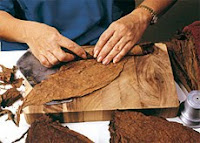
Firstly, in the production of tripa larga (long filler) cigars the binder leaves are laid out and the whole filler leaves are folded and aligned to allow the passage of smoke to travel along the length of the finished cigar. The most flavoursome ligero leaves are placed in the centre and are then wrapped in seco and then volado leaves on the outside. It is also constructed so that the intensity of flavour will increase as the cigar is smoked. These filler leaves are then tightly rolled using the binder leaves to ensure that they are compressed evenly along the length of the cigar.The dimensions follow strict guidelines for length, girth and weight. After 30 minutes in a wooden mould, the tocedor then applies the delicate wrapper leaf by stretching and straightening the leaf to ensure a perfect tension and appearance. Finally, a small piece of tobacco leaf is used to cap the head (the end that goes in your mouth) of the cigar, is cut off before smoking, and the other end is guillotined to size. A torcedor can produce 100-150 cigars a day. The completed cigars are then sent to be labeled, tested for quality, sorted and boxed.
The production of tripa corta (short filler) cigars is similar but they use the trimmings/parts of leaves left from the leaves used in tripa larga production, rather than the whole leaves. The bunch of trimmings is rolled tightly using a flexible mat and then the binder and wrapper leaves are applied in the regular way. In machine made cigars the three leaves are in much smaller pieces and are specifically blended. They are then tightly packed together and bound with a binder leaf and finished with a wrapper leaf by the machine.
Different sizesCigars come in all shapes and sizes and there are over 70 just from Cuba alone. The length ranges from four inches (100mm) to 9 inches (230mm), although most are between 5 and 7 inches. The other important measurement is the diameter or girth. This is measured by a system called the 'ring gauge' and this is measured in fractions of an inch (64ths of an inch to be exact!). The common range is between 23 (ie - 23/64ths of an inch or 9.1mm) and 52 (52/64ths of an inch or 20.6mm), although cigars are produced that are smaller and larger than this.
The length, diameter and shape of a cigar will effect the final taste and experience - a big, fat, long cigar will burn slower, be richer and softer in flavour and give cooler smoke to the palate whereas a thinner, shorter cigar will burn more quickly, give sharper flavours and hotter smoke on the palate. Each size has its own name or vitola, although it can get very confusing as a) the name given in the factory is different to the name that goes on sale and b) each factory has a different name for the same size of cigar.
Cigar and whisky matching
As stated at the beginning, the marriage of cigars and whisky is historical. Rumour has it that it all began during the Napoleonic wars in the early 1800s, when the British and Spanish were fighting to defeat the French - the British supplying the whisky from Scotland and the Spanish bringing their love of cigars from Cuba, which was part of their expanding empire. The trend has continued as the British moved from traditional pipe tobacco to cigars and then took the practice of combining whisky and cigars around the globe with the spread of the British Empire.
The most important thing to consider when matching whisky with a cigar (or indeed anything else - cheese, desserts etc) is to not have one that overpowers the other. A balance is needed so that one compliments the flavours and aromas of the other and vice versa. For example - a robust cigar matched with a light, fresh whisky would completely cover the subtle, vibrant notes in the whisky. Likewise, a very peaty whisky matched with a milder, creamier cigar would do the same. Generally, most cigars would seem to go well with a sherry cask matured whisky (these have extra sweetness and fruitiness that can deal with the strength of the tobacco) or a lightly peated/smoky whisky (these exhibit a similar strength of smoky flavour to the cigar). A more robust strong cigar would need a heavier, smokier whisky to combat its higher levels of aromas and flavour. Considering these factors when buying whisky and cigars will help, as will the advice of the people in the stores where you choose to buy them.
Check out the experts
We are new to the world of cigars and have tried to lay down some of the basics in this article. As we have found, once you dip your 'beginners' toe in to the water then you discover a lot more beneath the surface. The cigar industry can seem quite daunting from the outside but this is no different from the world of whisky, where a little basic knowledge can get you a long way. As in the whisky world, there are many people out there writing about and reviewing cigars. We have discovered numerous excellent blogs and sites, so check out some of these for much more information and expertise than we can offer - Cigar Jack, World of Cigars, Cigar Chick, CigarFox, Tobacconist University, Cigars4Women and our personal favourites Cigarblog and Cigar Inspector. In addition, our friends at the excellent WHISKYhost blog offer regular whisky and cigar matchings, including good combinations and tasting notes.
* Please note that all images used in this article have been taken from Google images.
Subscribe to:
Posts (Atom)