Showing posts with label explain about. Show all posts

Thursday, January 26, 2012

Post Burns Night blues?

robert burnsYesterday was Burns Night and if you attended some sort of celebration event, then you may be waking up with a slight hangover due to 'one too many' drams of whisky or have a slightly bloated feeling from eating too much haggis and clootie dumpling.  There is also a distinct possibility that once the whiskies began flowing later in the evening that the significance and origins of Scotland's unofficial national day can be forgotten.

A couple of years ago, we wrote a blog post explaining about the history, customs and facts about Burns Night and why it is heavily linked to the world of whisky.  Please click here to find out or re-aquaint yourself with the background behind this famous annual event.  However, if that hangover is hanging around and inhibiting your reading skills, then we have an alternative option ...

Yesterday, Matt met up with Clark McGinn, a good friend and supporter of Whisky For Everyone since we first met him two years ago.  Clark is a world authority and eminent speaker on Robert Burns, his poetry and his language - he has a website called seriousburns.com, has hosted hundreds of Burns Night suppers around the world and has a couple of books about the subject under his belt, including The Ultimate Burns Supper Book.

Clark kindly agreed to record a short video clip for us, in the midst of his busy schedule, that explains briefly about the origin and customs of Burns Night, plus what it has to do with whisky. Watch below as he also recites part of the famous Burns poem Address To A Haggis, which is traditionally read at Burns Night suppers.  Enjoy ...

Friday, November 26, 2010

Explain about > Buying whisky as a present

christmas presentWith Christmas fast approaching and the decorations are going up, people are starting to consider (or panic!) about what presents they are going to buy. Whisky is a popular choice and it is a time when people buy whisky either to enjoy themselves over the festive period or to give as a gift. For many shoppers or consumers, it may be the only time in the year that they purchase a bottle of whisky and it can be a daunting experience to go into a supermarket or specialist retailer. The ultimate question is - which one of the vast array of bottles on the shelves is the right one to go for?

Last Christmas, we wrote an article that tried to help with a few suggestions and things to think about when purchasing whisky as a present. Now, we have re-written and updated this article with further suggestions and new whisky releases. Naturally, the points can be used to buy whisky at any time of the year and not just at Christmas!

What do I need to consider?
It is a common misconception that you as a shopper need to know lots about whisky in order to buy something other than the big popular brands. This is not true. How much you know about whisky is actually not important at all - what has to be considered is what you think you the gift's recipient would like or prefer. If you are not sure, then think what other things and flavours that the person receiving the gift usually enjoys. This can be other spirits, wine, food etc - do they enjoy strong, rich flavours or something lighter and fresher? Do they drink white spirits like gin and vodka or sweeter, heavier ones like dark rum or Cognac? This will give you some clues. It may be that you know a whisky that the recipient of your present likes and you can ask for help in selecting something similar. Also think about if you want a famous brand/distillery or something a bit less well known.

How much do I want to spend?
Your budget is an important consideration. Set an upper limit - any salesman worth their salt will try and get you to spend more but stick to it! Single malt whiskies start around £25 for a 70cl bottle and most will be under or around £50. Blended whiskies can start for as little as £10 (sometimes even less if it is a supermarket own brand). Of course, there are whiskies that can fit any budget, from the cheap and cheerful to those costing hundreds and even thousands of pounds! If you only have a small budget, then you could buy a half sized bottle or a pack of miniatures - many of the companies release special gift packs at Christmas time. You can even buy a single miniature if you just need a stocking filler.

the whisky shop, london branchWhat are my shopping choices?
There are a few options - specialist whisky retailers, supermarkets, liquor stores and the internet. Specialist retailers, such as The Whisky Shop chain (the London branch is pictured, left) offer a wider range of whiskies and will have knowledgeable staff that can explain the differences and advise you to make the correct decision. These shops can be daunting but if you go in having considered the first two points, then they will be able to recommend you some great choices. They will also generally have some bottles of whisky open that you can sample and this can help you make a better decision.

Supermarkets are different in that they sell the products but staff may not know a great deal about them, especially as many have cut back on specialist wine and spirit staff in the recession. The distilleries marketing departments help you here, as many of them now print basic tasting notes on their packaging and this will give you an idea if you like the sound of it or not. The range will be tighter, although many chains will expand their whisky ranges and offer decent discounts around the festive period.

Liquor stores can vary from the knowledgeable to those that stock whisky but don't know much about it. Knowledgeable stores can be up there in the specialist retail league but the others can still offer some real hidden gems and great bargains, as they may not know what they have (ie - a rare whisky marked at a ridiculously low price). The trick is to pop in for cheaper beer or wine and have a nose around, then do a little research on the bottles you have spied.

With the internet there are many places to buy whisky - some are online specialists, while others are websites of the specialist whisky retailers or supermarkets - and many of these print helpful tasting notes on each page, with some giving more information, customer reviews and distillery facts to help you make your choice.

Our recommendations
If you consider each of the above points before shopping it will make your life, and that of the shop assistant, easier. We are now going to give some suggestions considering each of the points. Most of the whiskies recommended have been reviewed by us and more detailed tasting notes can be reached by clicking on the name of the whisky. We have split the whiskies in to the four main categories to cover the wide scope of flavours and tastes that could be encountered. Naturally, this is not definitive, as there are many nuances of flavour within each category ... but we hope it helps! We have set a budget of £30-35, as this is the most common price point for gift purchases of whisky.

benriach 12 years oldLight and fresh
This can be described as light, clean, delicate, fresh and crisp so look out for these words on packaging. Key flavour characters may be vanilla, cereal grains, nuts, grassiness (fresh or dried) and floral. Famous examples of this style are the Glenfiddich 12 years old, Glenmorangie Original and Glenlivet 12 years old. You could go for one of these as they are all very good and are some of the best selling whiskies in the world but what if you want something different. There are some very under rated whiskies in this category and ones worth considering included Glen Grant, Speyburn and Glengoyne which all release good 10 year olds. Also, there are the Benriach 12 years old (pictured, above) and AnCnoc 12 years old. For something slightly different, try the Japanese single malt Yamazaki 10 years old.

dalmore 12 years oldRich and sweet
These whiskies are much fuller bodied, sweeter and richer than the previous category. They can be described as thick and creamy and have key flavour words such as caramel, dried fruits and citrus peel, spicy and toffee. The Macallan 10 years old is the best selling and most well known brand of this style of whisky. There are many others worth considering including the Dalmore 12 years old (pictured, left), Glenrothes Select Reserve and Glenfarclas 10 years old, which are reasonably common. The Tomintoul 10 years old and Glendronach 12 years old are harder to find but worth tracking down. If you are wanting something non-Scottish then look towards something like the Bushmills Black Bush or a bourbon such as Bulleit Bourbon or Maker's Mark. Most bourbons would actually fall in to this category, as would the popular Tennessee whiskey Jack Daniel's.

A little bit smoky and peaty
This category is relatively small compared to the others. Generally, they are more robust but not always and have some of the peaty, earthy, smoky flavour and aroma but not as much as the next category. They tend to be from the islands around Scotland, but not always. The most well known examples of this style are the Talisker 10 years old, Highland Park 12 years old and Bowmore 12 years old. Other examples worth checking out include Ledaig 10 years old and Jura Superstition. Some whiskies have just the slightest hint of smoke and many people enjoy these as it is not too overpowering - Clynelish 14 years old, Springbank 10 years old, Tomintoul Peaty Tang and Glenfiddich Caoran Reserve 12 years old.

laphroaig quarter caskVery smoky and peaty
These are the big, heavy whiskies that are normally from the western Scottish island of Islay (although, again not always!). These will be labelled as rich, peaty, robust, fiery, earthy and smoky. If you see the word 'Islay' on an own brand supermarket whisky then 99.9 times out of 100, it will be in this style. The most famous and best selling brand of this style of whisky is the Laphroaig 10 years old. Laphroaig release another whisky in this £30-35 price bracket that is also very good and this is called Quarter Cask (pictured, left). Other quality whiskies to look for in this smoky style include Ardbeg 10 years old, Caol Ila 12 years old and Smokehead. If you want something smoky but not from Islay, then try the Benriach 10 years old 'Curiositas' from Speyside, Ardmore Traditional Cask from the Highlands or Longrow CV from Campbeltown.

Please note > the present image at the top of this post is taken from www.bargainshopper.com.au.

Wednesday, August 25, 2010

Explain about ... Mixers for whisky

whisky and lemonadeThe mixing of whisky with soft drinks has been popular since the Victorian times. This coincides with the rise of popularity of whisky, especially blended whiskies, and the need to find a lighter and more refreshing way to drink them as the British Commonwealth spread to hotter parts of the globe. This tradition has carried on and there is currently a huge upsurge of interest in whisky cocktails and the market is becoming flooded with pre-mixed whisky based drinks, such as the newly announced Famous Grouse & Cola.

We plan to sample and review some of these pre-mixed drinks in the near future but we thought that it was time to review some of the more common soft drinks that are regularly mixed with whisky to produce a long drink.

To do this, we have teamed up with Chris Maclean who writes Drink Station - arguably the UK's leading soft drinks blog. Chris is also a big whisky fan and we decided to choose mixers from one company's range of drinks - the innovative Fevertree Limited - so as to create consistency. Most people have tried a whisky and cola at some point so we also decided to ignore cola for now, instead concentrating on alternatives. After sampling the soft drinks together, Chris has written the tasting notes for each and we then discussed which whiskies we thought would go well with each one, listing some suggestions for you to enjoy and try. Click the links if you want to read our full tasting notes of the suggested whiskies. Happy mixing!

No artificial ingredients
Fevertree Limited is a company founded in 2000 and they sought to create an Indian tonic mixer from all-natural ingredients, including quinine (the bark extract of the Cinchona tree, colloquially known as the 'Fever Tree'). Fevertree launched the tonic water in 2005, and have since managed to redefine the mixer category by totally banning the use of artificial ingredients (they only use natural sweeteners and flavourings, and avoiding preservatives), taking instead a qualitative approach to drink formulation and packaging. They have since grown their product range and here we try a few of them, starting with the original tonic water.

fever-tree tonic, lemonade and ginger beerFever-Tree Premium Indian Tonic Water
DS > Fever-Tree tonic water is a bright, clear liquid. It exhibits a lively carbonation, with small bubbles rising steadily when the drink settles in the glass. An attractive, fresh, delicate aroma of lemon icing on the nose, with that familiar dusting of icing sugar. On the palate, fresh lemon citrus, with some supple acids producing a gentle tang. There is excellent balance here between the elements, as a stimulating lemony bitterness develops and persists on the finish. A quality mixer that speaks for itself, with a unique texture and flavour profile, that avoids the cloying, salty nature associated with artificial sweetener and preservative use.

WFE > Whisky and tonic may seem a little retro these days but is a very refreshing drink, especially with some ice and a slice on a hot day. We have used a lighter style of whisky when making this, such as Auchentoshan Classic or AnCnoc 12 years old single malts. This drink really lends itself to blended whiskies though, with something like Bell's or Famous Grouse being perfect.

Fever-Tree Lemonade
DS > Fever-Tree lemonade is a bright, colourless liquid. After the initial rush of carbonation, much smaller bubbles can be observed rising slowly through the liquid in the glass.. A fragrant, biscuity nose with sweet lemon. This is juicy, mouthwatering and with plenty of sun-warmed fruit. This is a lemonade that is soft and round in the mouth, with warm, biscuity citrus flavours. Supple acids again producing a gentle tang on the short finish.

WFE > Whisky and lemonade is a classic drink. You can really mix most whiskies with lemonade, with the exception of the smoky, peaty style which clashes quite unpleasantly. Any whisky with decent sweetness (but not full-on sweetness) and possibly some fruitiness is good - think of Balvenie Doublewood or Dalwhinnie 15 years old for single malts or something like Jameson's or Grant's Family Reserve for a blended whisky. Bourbons are also very good with lemonade.

Fever-Tree Ginger Beer

DS > Fever-Tree ginger beer is a cloudy, pale yellow colour that takes on a green hue when examined in the light. There is a fine sediment of ginger particles in suspension. Instantly aromatic on the nose, with fresh ginger in abundance. There is an extraordinary scent here, earthy and distinctly spicy- cumin? It's intoxicating stuff. Be sure you're sitting down for this one! An intense rush on the palate, with a controlled explosion of deep, freshly grated ginger flavour, topped with lemon and black pepper seasoning. This is as peppery and fiery as you could want, with that entrancing and utterly unique spicy, earthy cumin note intact. Predictably long finish as the chilli and fire trail off, this remains clean and refreshing throughout. A heady, entrancing experience; a one of a kind ginger beer that sets a stylish example.

WFE > Whisky and ginger beer is a slightly more niche drink than the more popular whisky and dry ginger ale (see below). Ginger beer tends to be spicier than dry ginger ale, so you need a whisky that is strong enough in flavour to combat and compliment this. We recommend something with a high level of sweetness, such as Macallan 10 years old or Glenfarclas 10 years old in the single malt category or something from the Whyte & Mackay range for the blends.

fever-tree soda water, ginger ale and bitter lemonFever-Tree Ginger Ale
DS > This is a mid lemon yellow colour. The liquid is clear and bright, and a lively carbonation soon settles down in the glass to reveal the small bubbles now rising steadily. Warm aromas of honey, lemon and discreet, freshly grated ginger. There is a lovely purity and depth on show here. Light yet satisfying flavours, as some subtle gingers tickle the palate with a trace of pepper spice. This is fresh, biscuity and clean. The ginger here never escapes the leash, always held in check by some more determined caramel notes. Within the light structure one finds an excellent balance, and a clean finish that are the hallmarks of these mixers.

WFE > The mixing of whisky and ginger ale is a throwback to the 1970s, but is a combination that can work brilliantly. The 'Canadian & Dry' is the classic, which uses Canadian Club whisky with Canada Dry ginger ale and is worth trying in a bar or if you can get the ingredients. If not, then try using any ginger ale combined with a whisky with plenty of vanilla and cereal notes, such as single malts like Glenmorangie Original or Glenlivet 12 years old. The Monkey Shoulder vatted whisky works superbly for this also.

Fever-Tree Soda Water
DS > Fever-Tree Soda Water is a bright, clear liquid. It is highly carbonated, with noticeably small bubbles rising steadily from various points in the glass when the drink settles. There is a very light, powdery scent to this, like a well diluted Alka-Seltzer or the spray of a vintage soda syphon. Lively mouthfeel, with the bicarbonate of soda pinging around the palate. Biscuity, with a creamy bite, like water biscuits covered in a thin layer of salted butter. A light bitterness precedes the short finish. A cleansing and refreshing mixer.

WFE > Whisky and soda is another old school classic combination. You can really use any style of whisky. The only exception is something smoky and peaty, where the soda water doesn't do it any favours. Again, like for the lemonade, something with a decent level of sweetness or fruitiness helps to create a more balanced drink.

Fever-Tree Bitter Lemon

DS > A pale yellow colour, slightly cloudy and with a wide watery rim developing towards the edge of the glass. The lively carbonation soon settles, and the trademark small bubbles settle in and tick over steadily. Concentrated lemon juice on the nose. Warm, appetising and juicy. There are powdery notes too, recalling lemon sherbet. This is aquatic, breezy and altogether nostalgic. A 'lemon grove' experience on the palate: Whole lemons, with pith, rind, oils, pips... Zesty and tangy, with good balance between the elements. Fresh and intense now with great clarity of flavour, leading to a bitter finale as the quinine comes through and adds length on the finish.

WFE > This may sound like a strange combination but with the right style of whisky, it is absolutely delicious. The whisky has to be light, fresh and used as an aperitif, otherwise it will overpower the bitter lemon and the final drink quickly becomes undrinkable. Single malts like Benriach 'Heart of Speyside' or Glen Grant Unaged are perfect, as would a light blend such as Bailie Nicol Jarvie.

All Fever-Tree drinks should cost approximately 75p for a 200ml bottle and are widely available from supermarkets and other specialist food stores in the UK and Europe.

* Please note - the image at the top of the post is taken from www.cocktailtimes.com. The centre and bottom images of the Fevertree drinks are copyright of www.drinkstation.blogspot.com.

Monday, May 10, 2010

Explain about ... Hosting your own whisky tasting

The idea of holding your own whisky tasting can be a daunting one. Here, we aim to show that with a few basic tips your event can be a successful and enjoyable for both you and the people you have invited. From our experience, a bit of research and attention to detail goes a long way to getting you off on the right footing. We believe that anyone can host their own whisky tasting event by considering a few simple steps. So, where do you start?

whisky bottles1 - Selecting the whiskies
This is the most important aspect of your tasting, as the whiskies are the stars of the show! This may seem obvious but the correct selection of whiskies can instantly make your tasting more interesting and diverse. The first thing is not to choose too many whiskies – 4 or 5 is a good number, otherwise everyone’s palates will start to struggle. But how do you choose correctly? The important questions are whether you want a theme and what do you want to portray within the tasting? Do you want different styles of whisky (this could be from different regions of Scotland or different whisky producing countries) or whiskies of same style (for example, all smoky whiskies). Do you want all well-known brands or lesser known ones?

One idea that works well for us is to pick whiskies that demonstrate the different core characteristics and barrel types of whisky – for example, choose 4 whiskies with one that has been matured in ex-bourbon casks, one in ex-sherry, one in a mixture of casks and then one smoky –this will show the typical flavour profiles of each style to your audience. If you are not sure or feel that you lack the knowledge to make the choices, then visit a specialist retailers either online or in a shop.

2 - Get interesting facts
Once you have selected your 4-5 whiskies, a good idea is to do some distillery research on those that you have chosen. This adds a further level of interest to your tasting. We are not just talking about a bit of history or information about the bottling (although this is useful especially with limited or single cask releases) but titbits of interesting related information. We call them the ‘pub quiz facts’ and your guests will leave knowing about other things than just whisky. One such example is that the golf course next to the Balvenie distillery has the highest hole of any golf course in the UK at 1000ft/305m!

There are many whisky blogs and websites where you can find such information and our interest in related facts led to us developing the ‘Did you know?’ section on each distillery profile page in our website whiskyforeveryone.com. It may help to prepare bullet pointed notes of these.

3 - Consider other accompaniments
The tasting is not just about the whisky. You will need some or all of the following items to help aid your tasting smoothly. The first is water – this is for both cleansing the palate between drams and diluting the whiskies if and when required. Filtered tap water is perfectly fine, although some insist you must have bottled water. Make sure that it is not carbonated and is at room temperature rather than chilled, which will inhibit the aromas and flavours of your whiskies. Another thing that helps to cleanse the palate between samples are oatcakes.

You may wish to include other food snacks during the tasting and discuss food and whisky matching. This is a current hot topic in the whisky world and information can be found on numerous websites. A spittoon or similar vessel is also a good idea, as some of your guests may not wish to swallow all of their whisky. Having said that, we have never seen anyone ever use one at any of the tastings that we have taken!


whisky glasses4 - Tasting the whiskies correctly
The physical process of tasting whisky is simple and is about preparing your senses properly in order to get the most out of each whisky (ie - the aromas on nose and the flavours on palate and finish). The first consideration is the type of glassware that you use. Ideally, you need a tulip shaped glass with a tapered rim. These are similar to a wine tasting glass and do the same job – they hold in the aromas and maximise the effects of the nose. A wider rimmed tumbler style of glass allows a lot of the aroma to dissipate away from your nostrils. When sampling your selection of whiskies, then start with the lightest, freshest one and move through to the heaviest, sweetest or strongest one. This is the same as in a wine tasting, where you start with the whites before moving to the reds and then dessert wines. If you do it the other way around, the stronger flavours will taint the palate and the subtleties of the lighter whiskies are in danger of being lost.

The most important step is to get to the whisky! It is easy to procrastinate about this or that or the other, but most of your crowd will just want to try the stuff and see what it is like. Whisky tasting is different from a wine tasting as the alcohol levels of what is in the glass are much stronger. To help with this, it is an idea to get your tasters to prepare their senses properly for what they are about to do to them, especially if they are not used to spirits. Get them to smell the whisky two or three times and as their noses get more used to it, then they should start to pick up more and more characteristics. The same will happen on the palate – the more they hold the whisky in their mouths, the more flavours they will find. You should also talk about the effects of adding water and ice, as someone WILL always ask about it!

whisky tasting5 - Make it interactive
The whisky tasting must be a combination of fun, informative and interactive. Encourage your guests to ask questions, make comments and discuss the whiskies between themselves. It is also good to get people to come up with own tasting notes and think about what they are tasting, rather than you telling and dictating to them what aromas or flavours that they should be finding. This will make it more interesting for you and your tasters and get them thinking more about the whiskies. If it is a bit slow to get going then don’t worry - after a couple of drams they will start to loosen up! Most importantly, is that you and your guests enjoy the event and the whiskies. Good luck!

We thank Stephen Smith from Minneapolis, USA for the idea for this post. Steve won our recent 2nd birthday competition, where we asked for ideas for interesting articles that people would like to see.

If you are holding your own whisky tasting event, then we would love to hear how it went – just add your comment in the section below.

Tuesday, March 9, 2010

Explain about ...Cigars and whisky

A marriage made in heaven?
The association between whisky and cigars has a long history and is one that remains strong. Many people enjoy a dram of whisky with a cigar as an evening pastime, as part of a celebration or just for enjoyment. We recently had the opportunity to learn more about cigars at a beginner’s class operated by Hunters & Frankau, the UK’s leading independent importer for Cuban cigars.

Hunters & Frankau
have been trading since 1790 and you can learn more about them and their range at www.cigars.co.uk. As we knew nothing about cigars before the class, we decided to write this post to show some basics that were learnt and will help us understand more. We hope this helps if you find yourselves in a similar position to us! We will concentrate on the Cuban cigar industry, although tobacco is grown and many of the same practices are followed in other countries around the world. Here goes ... it's a long one!

map of cubaWhy Cuba?
Cuba is regarded by many as the spiritual home of cigar production and is renowned for producing some of the world’s finest cigars. It is home to some of the world’s best known cigar brands such as Romeo y Julieta, Montechristo and Cohiba. Cuba is a Caribbean island that lies between the southern tip of Florida, USA and the island of Jamaica. Cuba’s climate and fertile soil gives it ideal conditions for growing tobacco plants and the island has a rich heritage connected with tobacco. When Christopher Columbus landed on Cuba in 1492, he was greeted by the natives and was offered cohibas (the Spanish word for cigar) and tobacco plants as gifts. It is believed that the cohibas formed part of the island’s ceremonial festivals. Columbus cannot have realised the immense effect that his ‘discovery’ would have on the world!

tobacco plantsThe tobacco plant
Tobacco plants have large flat leaves and in the cigar industry these leaves are graded. The plant is split in to three sections – the leaves at the base are called volado, the leaves in the centre are seco and the leaves at the top are ligero. Each type of leaf has its own properties and is used in different parts of the cigar and cigar making process. It is believed that all of the native tobacco plants on Cuba are directly descended from the plants that were around when Columbus arrived over 500 years ago. The Cuban Black Tobacco (Latin name tabaco negro cubano) was a wild plant before it was first farmed and cultivated in the 16th century. It is grown in defined regions (similar to the ‘denomination of origin’ system in wine – ie: Champagne, Chianti, Rioja etc), and each has an exceptional soil and micro-climate to produce high quality tobacco. These are called the Vegas Finas de Primera and there are four –

*Vuelta Abajo (on the far western tip of Cuba and regarded as producing the best tobacco in the world)
*Semi Vuelta (still on the western peninsula but further inland)
*Partido (further east and the closest region to Havana, Cuba’s capital)
*Vuelta Arriba (this is split in to two areas – one in Central Cuba called Remedios, which is the oldest growing area in Cuba and one on the eastern peninsula called Oriente).

Different types of cigars
There are two methods of making a cigar – by machine or by hand. The machine made cigars are named mecanizado in Cuba and the hand made cigars or totalmente a mano, fall in to two categories – tripa larga and tripa corta. The tripa larga are known as long filler cigars in English and are made from complete tobacco leaves. Tripa corta cigars are also known as short fillers and are made using chopped tobacco leaves or picadura in Spanish.

The anatomy of a cigar
A cigar is made up of three parts – the filler, the binder and the wrapper. Each part uses leaves from the different parts of the tobacco plant to fulfill different functions. The filler forms the main body of the cigar and is made using a combination of the three classification of leaf from the tobacco plant – the volado, seco and ligero. These give the cigar its main flavour profile. The volado leaves from the base of the plant are mild in flavour, the seco leaves from the middle are more flavoursome and the ligero leaves from the top have the most intense flavour. This is due to the ligero undergoing more photosynthesis and being younger and fresher than the lower leaves on the plant. It results in the ligero having more sweetness and a darker colour than the volado and seco when they are dried.

The blend of the three filler leaves is then secured with a binder leaf. This holds them together and these binder leaves are taken from the top part of the plant, but undergo a slightly different treatment to the filler ligero leaves. The final part is the wrapper leaf, which contributes little flavour but is secured tightly in order to present the cigar in the best way. These wrapper leaves are grown in a different way and produce the most expensive tobacco. They are grown for a majority of the time under a muslin cover and this filters the sunlight and traps heat, allowing the leaves to grow larger and finer. By contrast, the leaves for the filler and binder leaves are grown in the open and under direct sunlight. In summary, five leaves are used to produce a cigar – three fillers for flavour, one binder for structure and one wrapper for presentation.

tobacco curing barnHow cigars are made by hand?
Once fully grown, the tobacco leaves are harvested and graded depending on their role in the final cigar. The leaves are harvested in stages, with the base leaves being taken first and the others being taken over the following 30 days, finishing with the youngest top leaves of the plant. The leaves are taken to a casas de tabaco or curing barn and are hung in pairs on large racks. This removes moisture, with the leaves turn golden brown over time. The wrapper leaves take around 25 days for this to occur. The binder and filler leaves are given about twice as long.

The leaves are then placed in piles and undergo natural fermentation (similar to a garden compost heap), removing many impurities. The ligero filler leaves and wrapper leaves take around 30 days for this to happen, with the seco and volado filler leaves and the binding leaves taking 25 days. Following this, the leaves are sorted by size, texture and colour before the filler and binder leaves undergo a second fermentation stage. The times vary with the volado and binders having a further 45 days, the seco around 60 and the ligero having up to 90.

They are then gathered in to bundles and wrapped in hessian to be aged. These bales are called pacas. The volado are aged for a minimum of nine months, seco for 12-18 months and ligero for two years. The wrapper leaves do not undergo a second fermentation but are packed in similar bales after the sorting process. These bales are called tercios and are made from the bark of palm trees. wrapper leaves are aged for a minimum of six months.

Before the cigar is made, the leaves must be moistened, checked for classification and stripped of their stems. The leaves are then passed to a ligador or master blender, who constructs the complex blend for the brand of cigar that is to be made. The exact ratios of each type of leaf that goes in to the blend is a closely guarded secret that only the ligador knows. The blend of leaves is then passed to the torcedores, the highly skilled craftsmen and women who hand roll the cigars (torcedoras for the ladies!).

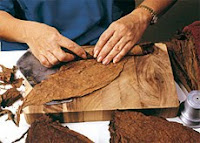
torcedora rolling tobaccoFirstly, in the production of tripa larga (long filler) cigars the binder leaves are laid out and the whole filler leaves are folded and aligned to allow the passage of smoke to travel along the length of the finished cigar. The most flavoursome ligero leaves are placed in the centre and are then wrapped in seco and then volado leaves on the outside. It is also constructed so that the intensity of flavour will increase as the cigar is smoked. These filler leaves are then tightly rolled using the binder leaves to ensure that they are compressed evenly along the length of the cigar.

The dimensions follow strict guidelines for length, girth and weight. After 30 minutes in a wooden mould, the tocedor then applies the delicate wrapper leaf by stretching and straightening the leaf to ensure a perfect tension and appearance. Finally, a small piece of tobacco leaf is used to cap the head (the end that goes in your mouth) of the cigar, is cut off before smoking, and the other end is guillotined to size. A torcedor can produce 100-150 cigars a day. The completed cigars are then sent to be labeled, tested for quality, sorted and boxed.

The production of tripa corta (short filler) cigars is similar but they use the trimmings/parts of leaves left from the leaves used in tripa larga production, rather than the whole leaves. The bunch of trimmings is rolled tightly using a flexible mat and then the binder and wrapper leaves are applied in the regular way. In machine made cigars the three leaves are in much smaller pieces and are specifically blended. They are then tightly packed together and bound with a binder leaf and finished with a wrapper leaf by the machine.

cigar size chartDifferent sizes
Cigars come in all shapes and sizes and there are over 70 just from Cuba alone. The length ranges from four inches (100mm) to 9 inches (230mm), although most are between 5 and 7 inches. The other important measurement is the diameter or girth. This is measured by a system called the 'ring gauge' and this is measured in fractions of an inch (64ths of an inch to be exact!). The common range is between 23 (ie - 23/64ths of an inch or 9.1mm) and 52 (52/64ths of an inch or 20.6mm), although cigars are produced that are smaller and larger than this.

The length, diameter and shape of a cigar will effect the final taste and experience - a big, fat, long cigar will burn slower, be richer and softer in flavour and give cooler smoke to the palate whereas a thinner, shorter cigar will burn more quickly, give sharper flavours and hotter smoke on the palate. Each size has its own name or vitola, although it can get very confusing as a) the name given in the factory is different to the name that goes on sale and b) each factory has a different name for the same size of cigar.

Cigar and whisky matching
As stated at the beginning, the marriage of cigars and whisky is historical. Rumour has it that it all began during the Napoleonic wars in the early 1800s, when the British and Spanish were fighting to defeat the French - the British supplying the whisky from Scotland and the Spanish bringing their love of cigars from Cuba, which was part of their expanding empire. The trend has continued as the British moved from traditional pipe tobacco to cigars and then took the practice of combining whisky and cigars around the globe with the spread of the British Empire.

The most important thing to consider when matching whisky with a cigar (or indeed anything else - cheese, desserts etc) is to not have one that overpowers the other. A balance is needed so that one compliments the flavours and aromas of the other and vice versa. For example - a robust cigar matched with a light, fresh whisky would completely cover the subtle, vibrant notes in the whisky. Likewise, a very peaty whisky matched with a milder, creamier cigar would do the same. Generally, most cigars would seem to go well with a sherry cask matured whisky (these have extra sweetness and fruitiness that can deal with the strength of the tobacco) or a lightly peated/smoky whisky (these exhibit a similar strength of smoky flavour to the cigar). A more robust strong cigar would need a heavier, smokier whisky to combat its higher levels of aromas and flavour. Considering these factors when buying whisky and cigars will help, as will the advice of the people in the stores where you choose to buy them.

Check out the experts
We are new to the world of cigars and have tried to lay down some of the basics in this article. As we have found, once you dip your 'beginners' toe in to the water then you discover a lot more beneath the surface. The cigar industry can seem quite daunting from the outside but this is no different from the world of whisky, where a little basic knowledge can get you a long way. As in the whisky world, there are many people out there writing about and reviewing cigars. We have discovered numerous excellent blogs and sites, so check out some of these for much more information and expertise than we can offer - Cigar Jack, World of Cigars, Cigar Chick, CigarFox, Tobacconist University, Cigars4Women and our personal favourites Cigarblog and Cigar Inspector. In addition, our friends at the excellent WHISKYhost blog offer regular whisky and cigar matchings, including good combinations and tasting notes.

* Please note that all images used in this article have been taken from Google images.

Monday, May 5, 2008

Explain about ... Adding Water Or Ice To Whisky


'Should i add water or ice to my whisky?' is a question that we get asked very often, particularly by those beginning their whisky journey. Adding water or ice can change whisky in both a positive and negative way. The most important thing to remember is that there is no right or wrong answer, despite what you may have read or seen. Ultimately, what you add to your whisky is all down to personal taste.

In reality, most whisky already has some water added. Many people do not realise this. The process is called 'cutting' and is done before bottling. This is in order to bring the alcohol down from the high ABV strength that it may have been in the cask (often between 50-60% ABV) to a more acceptable and drinkable level for the majority of consumers, which is normally between 40-46% ABV. The water used is usually local spring water.

Often you will see or read people saying that you should never add water. We have heard some connoisseurs saying that you should not add any water because then you are tasting the whisky in its natural form with all of the original distillery characteristics and flavours. That is their own personal prerogative and choice.

However, it is worth noting that everyone that either produces whisky or creates the products that we drink - the distillers and Master Blenders - always add water when analysing the spirit off the still or whiskies to be used in a blend or single malt. This helps them to maximise the aromas and flavours to give a full analysis. They will often add different amounts too to see how the spirit or whisky performs.

By adding water to a whisky you can open up different, new and subtle flavours that you previously had not experienced. This is particularly true when drinking cask strength whiskies with higher alcohol levels (this can be up to and over 60% ABV in some cases). With cask strength whisky the alcohol and resulting burning in your mouth can overpower even the most prominent flavours.

By adding some water this dilutes the alcohol and reduces its influence, giving both the prominent and more subtle flavours a chance to shine. Imagine drinking orange squash concentrate without any water and then with water... it's essentially the same idea. How much water you add is entirely up to your taste - a few drops, a dribble, a dash ... it's your choice, and to your taste.

Water is water, right? Well no - the type of water you add to your whisky can also make a difference. Forstly, it should always be still water. Carbonated or sparkling water will effect the flavour and structure of the whisky when you add it. This is good for a nice refreshing highball-style cocktail, but not general drinking or analysing.

Tap water is treated with chemicals, especially chlorine and fluorine, and these can alter the flavour. Do you live in a hard or soft water area? Spring water is similar as it has permeated through rock over hundreds of years, picking up salts and minerals on its journey. It is best to find the most neutral water you can - this will dilute but not add any flavour to your whisky.

Adding ice is slightly different. Rather than enhancing aromas and flavours, as water can, it actually inhibits them as the ice makes the temperature of the whisky drop rapidly. This locks down the aroma and flavour compounds. It is similar to drinking a good white wine that has been chilled down too much. It will be refreshing to drink but taste a little dull and flat, and will only start to open up and reveal its full character once it starts to warm up.

The important thing about all of this is not to get too hung up on it. Experiment with different whiskies and different levels of water to find your perfect amount and combination. By doing this you will find your own way of drinking your whisky and keep it fun.

* Please note / this post has been updated from the original - July 2020.