

Showing posts with label jim beam global. Show all posts
Showing posts with label jim beam global. Show all posts
Friday, January 17, 2014
Inbox - January 17, 2014


Wednesday, November 7, 2012
Have just tried - Jim Beam Honey

Friday, August 17, 2012
Inbox - August 17, 2012
Within Inbox we write a few lines detailing each press release/piece of news/PR event that we have received and provide links, where possible, for you to find out further information. So what has grabbed our attention this week? Find out below ...
________

The award winning independent Isle of Arran distillery have appointed their latest 'Ambassador of Arran'. Keiko Manni (pictured, left) from Japan has been appointed to help drive sales of Arran single malts in the country. Manni is the Spirits Buying Leader for Isetan, a prestigious department store in Tokyo, and has helped establish the brand and increase sales significantly during the last five years in Japan.
Manni was awarded her 'Ambassador of Arran' title during a recent trip to the distillery. She was accompanied on the trip by Sueko Yamada, a colleague at Isetan. During their visit, they selected a single cask to be sold exclusively in Japan through Isetan. With the help of Arran's Master Distiller James McTaggart and Senior Brand manager Louisa Young, they selected an ex-bourbon cask which was distilled in 2001.
Louisa Young, the Senior Brand Manager at Isle of Arran Distillers said, “Our export sales to Asia are significant and Japan is a key market for us. Keiko has long been a champion of our wonderful range of single malts, so we were delighted to host them as our guests on this trip organised by our Japanese distributor Whisk-e. It is great to see that the role of females within in the whisky industry has increased on a global level and they are more than making their mark in highly regarded, influential positions.”

The owners of the multi-award winning Kilbeggan and Cooley Irish whiskey distilleries, Beam Golbal, has hired five Irish graduates to promote its Irish whiskey brands in the USA. The graduates - Emily Duffy from Limerick, Joanne Ryan from Waterford and Ruth Dunne, Michael Egan and Jennifer Graham (all from Dublin) - will each be based in one of five US cities - Boston, Chicago, New York, Philadelphia and San Francisco.
The graduates have been immersed in all aspects of Irish whiskey during a training session at the Kilbeggan distillery and tutored on how to market Irish whiskey to an overseas audience. They will work with the Kilbeggan distilling team on every aspect of whiskey production from distillation to maturation and received a whiskey master class from Beam’s Irish Whiskey Global Brand Ambassador John Cashman.
Beam’s Senior Global Marketing Manager for Irish Whiskey, Stephen Teeling, commented, “These talented graduates will be supported by Beam’s US marketing and distribution infrastructure as they promote our portfolio of Irish whiskeys in five major cities in the US. This program has huge potential for producing highly skilled people, who possess the talent and ability to successfully market Irish products overseas. There is scope to roll this program out across Europe and in other international markets.”

The popular Chivas Regal blended whisky brand has announced a new annual collaboration programme and details of the first participant. The scheme will see the Chivas Regal 12 years old expression presented in uniquely designed packaging by a series of modern craftsmen. The first edition is called Made For Gentlemen and has been designed by leading footwear designer Tim Little, the Creative Director and owner of iconic luxury British shoe brand Grenson.
Little's packaging features a deconstruction of the pattern pieces of leather needed to make a classic brogue style of shoe and will be available to buy from selected retailers from the beginning of September. The Chivas Regal 12 years old Made For Gentlemen will retail for a special price of £25.39. For further information, visit the Chivas UK Facebook page.
Wednesday, April 25, 2012
New release - Connemara 12 years old

Cooley was founded in 1987 by John Teeling and his idea was to resurrect some of Ireland's oldest whiskey recipes and traditions that had become extinct. He converted an old vodka distillery and Cooley has since won over 100 awards worldwide. At the end of 2011, the distillery and company were taken over by drinks giant Beam Global. The first expression of the modern Connemara was launched in 1996 - this 12 years old is actually the oldest version of Connemara released to date.
Connemara, which is named after the original site of the Connemara distillery on the west coast of Ireland near Galway, and its old traditional recipe had disappeared into history before being resurrected by John Teeling. To produce this expression of Connemara, some of their oldest premium casks were used. There are just 7,000 bottles available, although it is planned for the 12 year old to become a regular annual release. This version has been bottled at 40% ABV and should cost around £60-65 from specialist liquor retailers.
Our tasting notes
The colour is a pale golden yellow and the nose has a delicious freshness to it. There are a number of aromas that help to give it this freshness and these include green pear and apple, honey, vanilla and a hint of lemon zest. Backing this up are deeper notes of malty cereals and mossy, earthy peat - this peat is not as obvious or vibrant as in younger versions of Connemara, but instead softly drifts around your nostrils.
On the palate this feels soft and creamy, almost a little bit oily in texture. There are prominent notes of vanilla and honey, which are backed up by malted barley and a hint of yeast - this combination is reminiscent of bread dough. The fresh green fruitiness from the nose is still there but has taken a bit of a step back, while the zesty lemon has come more to the fore and has a lemon meringue pie feeling. The earthy peat smoke is never far away and makes you think of damp moss. It comes across a touch more feisty than on the nose and it has a mild chili-like heat and spice to it. The combination is sublime and very moreish.
The finish has a decent length, although it is the peat smoke and tingling heat that last longer than anything else. The sweet vanilla, honey and malty notes, plus the zesty lemon fade quite quickly and leaves a slightly dry feeling in the mouth.
What's the verdict?
This is a good effort from Connemara and shows an increased depth, complexity and class from its very good younger siblings. Also, the smokiness is less prominent and more integrated than in other expressions. The only slight disappointment is the lack of depth in the finish and this stops it from being a great whiskey in our opinion. Having said that, it is lovely, easy to drink and very enjoyable.
Thursday, March 8, 2012
New release - Jim Beam Devil's Cut

The Beam family have a long whiskey heritage, with their first distillery dating back to 1795. This was founded in Washington County, Kentucky by a German immigrant called Jacob Boehm (his surname later became Americanised to Beam). The current distillery was founded in 1933 at the end of Prohibition in the USA and is located in the town of Clermont in the famous whiskey producing state of Kentucky. It is currently run by the seventh generation of his family - the Master Distiller is Fred Noe, who is the great grandson of Colonel James B. Beam (or Jim Beam as he is famously known).
We were delighted to meet Fred Noe at an event in London earlier this week and he had managed to sneak a bottle of Devil's Cut in to the UK for it. When talking to Fred, he was immensely proud of Devil's Cut as it is the first new product for the core range that he has personally developed since he became Master Distiller five years ago. The story behind the whiskey and the name as Fred tells it is as follows ...
When whiskey is maturing in a cask it is pulled in and out of the wood as time progresses. When the cask is emptied for bottling, some of this whiskey remains in the wood and is potentially lost. By using a technique called 'sweating', some of this whiskey can be removed from the wood - this involves putting about two gallons (7.5 litres) of water in to the empty cask and shaking the cask for around 30 minutes. This pulls some of the whiskey out of the wood and this 'whiskey water' is then drained off and used to dilute the final product, instead of regular spring water. The 'devil's cut' is the name given by Fred to the whiskey trapped inside the empty cask, as it is the opposite to the 'angel's share' which is evaporated alcohol that has escaped from the cask during maturation.
Our tasting notes
The colour of Devil's Cut is a rich golden yellow and the nose is packed with expressive aromas. There is plenty of immediate vanilla, coconut and brown sugar. There is also a scent of distinct malty cereals and some toasted oak, which are backed up by more subtle wood spices (think of nutmeg especially) and a hint of burnt orange. It is very, very promising indeed.
On the palate, this is rich, velvety and pleasantly oily with plenty of initial sweetness. The main notes here are vanilla, honey, butterscotch and caramel and this makes it feel very soft. However, it is not long before other elements kick in and balance that intense opening sweetness. Included here are some robust cereals (these are not as sweet and malty as on the nose, but more bittersweet), burnt orange, toasted almonds and plenty of lovely, tannic wood spice - imagine cinnamon, nutmeg and oak. The oaky note seems to increase as you let the whiskey sit in your mouth for longer. The balance and harmony of all of the combined elements is sublime and very good. The strength suggests adding a few drops of water and with this, it becomes creamier and even softer with the vanilla coming to the fore and the woody spices being knocked back slightly.
The finish is very long with the woody spices and robust cereals lingering for what seems like forever. Again, it begins sweetly but the spice/cereals take over quickly and leave your mouth watering and wanting more. There is a delicious hint of the burnt orange which rounds everything off perfectly.
What's the verdict?
The Jim Beam Devil's Cut is an absolutely superb whiskey and one of the best in the bourbon category that we have ever tasted. It excellently combines good sweetness with delicious, gripping woodiness and spiciness. The Devil's Cut has won rave reviews in America and is taking that market by storm. It should do the same when it hits its new markets later this year and it deserves to.
Hats off to Fred Noe, as he has produced a stunner of a whiskey. If you are in the USA - lucky you, go out and buy a bottle now. If you're not (like us) - make a mental note and keep your eyes open for when it get released. You won't be disappointed.
Tuesday, July 26, 2011
Have just tried > DYC Ocho Años Special Reserve
 DYC whisky is produced in Spain and this Ocho Años (eight years old) bottling forms part of a core range, which also includes the best selling Regular blend and the Pure Malt - the only Spanish single malt whisky. Many people do not even realise that Spain has a whisky industry (including us before we discovered DYC on a trip there a few years ago) but it makes sense when you learn that Spain is the fourth largest consumer of whisky in the world, behind only France, the USA and the UK. The Ocho Años is a blended whisky, in which the youngest whisky included is eight years of age. It is bottled at 40% ABV and is available in larger supermarkets and liquor stores in Spain for the very reasonable price of €15.
DYC is the abbreviated company name of Destilerias y Crianza del whisky, which opened Spain's first whisky distillery in 1959. The distillery is located in the town of Palazuelos de Eresma in the Castilla y Leon region to the north west of Madrid. It is a massive distillery complex that has the capacity to produce 20 million litres of spirit per year (this is almost double the capacity of Scotland's biggest whisky distillery at Glenfiddich). DYC is owned by the multi national drinks company Beam Global and they make other alcoholic spirits under license at the distillery. The whisky is marketed to be low budget and is very popular in Spain, being much cheaper than imported Scottish, Irish or American whiskies. It is designed to be mixed with non alcoholic beverages or ice and to be easy drinking in the hot weather.
Our tasting notes
The colour of this Ocho Años is a light golden yellow and the nose is also light, with some gentle understated aromas combining nicely. These fall in to two categories - sweet (vanilla, honey and butterscotch) and non-sweet (cereals, dried grasses and some lemon zest). It gives the impression of being refreshing to drink. On the palate the whisky exhibits basic characteristics, with contrasting elements working nicely together. This time there is a mix of soft, creamy notes such as toffee, honey and vanilla, plus tangy and drier notes like robust cereal grains, dried grass, fresh lemon juice and some spicy oak. The combination is interesting and gives that refreshing nature that the nose suggested. There is no massive complexity here but that is no bad thing, as all the notes are well balanced. The finish is a little more robust and is particularly grainy, with plenty of bittersweet cereals gripping your tastebuds along with a decent amount of drying oak and tangy lemon zest.
What's the verdict?
This DYC is a simple but very pleasant and easy drinking whisky. It has basic characteristics in abundance but lacks a little depth and complexity. However, this makes it refreshing and ideal for drinking in a hot climate, which is what it is designed for. It also offers good value for money and this is why we snaffled a bottle for our collection on our travels to Spain. Next time that you are in Spain and you see some DYC behind a bar, why not order a dram and try it for yourself?
Tuesday, May 31, 2011
New releases > Jim Beam Red Stag
 Iconic American producer Jim Beam, the world's best selling bourbon, have launched a new product on to the UK market called Red Stag - a version of the famous Jim Beam White Label bourbon which has been slowly infused with natural black cherries. Bottled at 40% ABV, Red Stag will retail at £21.75 a bottle and is currently available from the Tesco and Asda supermarket chains. It is recommended to be consumed straight, chilled or as part of a cocktail. We were delighted to be invited to the UK launch party recently - footage of which can be seen in the video clip below.
Jim Beam is the biggest selling bourbon brand in the world and sits comfortably in the global top 10 for total spirit sales. The current distillery was built at the end of the Prohibition period in 1933 and is located in the town of Clermont, Kentucky. The state of Kentucky is the famous home to America's bourbon industry. The Beam family have a longer whisky heritage, with their first distillery dating back to 1795. This was founded in Washington County, Kentucky by a German immigrant called Jacob Boehm (his surname later became Americanised to Beam). The distillery is currently run by the sixth generation of his family. The Beam empire has grown massively and Beam Global are now one of the biggest drinks companies in the world, holding a vast array of worldwide brands in their portfolio including the famous Scottish whisky distillery of Laphroaig.
Our tasting notes
We have tasted Red Stag straight and at room temperature for these notes. The colour is a rich golden yellow and the nose is delicious and rich. It is packed with vanilla, oak, coconut and sweet cereal grain aromas from the bourbon, with the addition of ripe red cherries (think of a cocktail/maraschino cherries) . More sweet aromas come through in the form of honey, as does an interesting floral note (imagine honeysuckle or maybe orange blossom). On the palate, the vanilla and oakiness are immediately prominent before quickly being complimented by plenty of sweet, luscious and juicy black cherry flavours. The liquid feels rich, soft and warming in your mouth. The warmth is quite spicy with hints of cinnamon and nutmeg) and further mellow sweetness created by the cereal grains and honey notes. The finish is long with a combination of the cherry sweetness and the drier, oaky bourbon characteristics vying for attention. The warm spices (cinnamon and nutmeg) really come through as does a citrus note, reminiscent of candied orange peel, before one final blast of sugary cherry.
What's the verdict?
The Red Stag is certainly unique. Other American companies have produced similarly infused items - think of Evan Williams' Honey or the recently released Jack Daniel's Honey - but we have not tasted or come across a bourbon infused with fruit. Is it a gimmick? We don't think so and we both really enjoy it. We like the idea of new products that try and attract new drinkers, as long as they are of a good quality and well produced. Red Stag is good taken straight but is better chilled from the fridge and sipped from a shot glass or as part of a simple cocktail.
Cocktail idea?
We came up with an Old Fashioned type cocktail which seems to suit Red Stag well and tastes delicious - all you will need is a tumbler glass, some orange zest, ice cubes and Red Stag. Put the orange zest in the tumbler style glass, add three or four ice cubes and a good measure of Red Stag. Stir for a minute or so with the end of a spoon, repeat the ice cubes/Red Stag measure and stirring stage, before garnishing with a fresh red cherry (or a maraschino cherry if real cherries are out of season). Yum :)
Monday, January 10, 2011
Our Top 10 whiskies of 2010 > Part 2
 2010 has seen many new whiskies released on to the market. We have sampled and reviewed a number of these over the last year at Whisky For Everyone, so we have decided to choose our top 10 favourites of these new releases. A similar Top 10 that we published this time last year has proved to be one of our most popular ever and we hope that this one is enjoyed as much. Please let us know what you think of our choices by leaving a comment at the bottom of this post.
Such Top 10s are always subjective and therefore contentious as a result - everyone has differing opinions at the end of the day. We have tried to select our Top 10 on a ratio of quality, value for money and availability to the public. To this end, there are not really any single cask or independent bottlings included, despite some excellent ones being sampled throughout the year. However, some are limited edition bottlings that are still available to purchase.
We have split our Top 10 in to two parts – to read the first part, released last week and containing numbers 6-10, click here. Numbers 1-5 and our ‘Whisky of the Year’ can be found below. So, drum roll please! Our top five is …
 WHISKY FOR EVERYONE
WHISKY OF THE YEAR 2010
1 > Bowmore Tempest
The Tempest is a small batch bottling that is released approximately twice a year – Batch 1 (of which our sample is from) was released in early 2010, with Batch 2 coming in mid 2010 and the next batch penciled in for release in early 2011. This was matured in specially selected first fill ex-bourbon casks and is bottled at 10 years of age. The nose is a wonderful combination of sweet and smoky aromas - caramel, butterscotch, marshmallow, malty cereals, dark dried fruit and damp, earthy moss. The palate feels creamy and rich with sweet butterscotch, vanilla, toffee, honey, tangy citrus, mossy smoke, wood spice and a hint of salt. The finish is very long and smoky, with bitter iodine adding further complexity to the many other notes. This is an exceptional whisky that offers incredible complexity and balance. It was our unanimous choice as our favourite whisky of 2010. We can’t wait to try the forthcoming version of the Tempest!
Click here to read our original post about Bowmore Tempest.
 2 > Balvenie 14 years old Golden Cask
The whisky is bottled at 14 years of age and has been part matured in Caribbean rum casks, hence the name Golden Cask. It was released last February and is one of Balvenie’s exclusive Duty Free/travel retail bottlings. The nose is fresh, perfumed and vibrant with plenty of captivating aromas - the combination is excellent and tempting, making you want to just sit and sniff the whisky forever. The palate is fresh, juicy, sweet and intense. There is vanilla, oak, cereal grains, sweet honey, orange zest, sandalwood, nutmeg and crumbly brown sugar. The finish is again intense and begins sweetly before becoming much drier and spicier. This is a delicious whisky and one that mixes its more obvious sweeter notes with the understated subtle ones. Great value for money – grab a bottle next time you go through an airport.
Click here for our original post about Balvenie Golden Cask.
 3 > Laphroaig Triple Wood
Another Duty Free/travel retail exclusive whisky. Triple Wood has been matured in three different types of cask - ex-bourbon cask, then quarter cask and then ex-Oloroso sherry casks. The whisky is only produced in small batches, the latest of which was released last Summer. The nose is expressive with intense earthy peat and bitter iodine, before these mellow to allow other notes through to create an intense combination - caramel, raisins, prunes, honey, vanilla and oatcakes. The palate is softer than expected. Rich peat smoke mixes with caramel, almonds, honey, dried fruit, brine and bitter iodine. The finish is long, with peat smoke burning away for ages. This Laphroaig is a lovely dram and a very good example of a peaty, smoky whisky. A wonderfully crafted, expressive and complex dram.
Click here for our original post about Laphroaig Triple Wood.
 4 > Double Single by Compass Box
This bottling was released as part of the Compass Box 10th anniversary celebrations. It is made from just one cask of single malt and one cask of grain whisky and is a limited edition of just 876 bottles. The nose is fresh, vibrant and very promising with a complex combination of aromas - vanilla, green apple, nuts, oak, fresh coconut, dried grass, cereals and kiwi fruit. The palate is delicious, juicy, tangy and fresh with many of those notes from the nose present. The finish is short and vibrant with sweet vanilla and honey notes. This is a cracking whisky. It offers an insight in to how good and complex a lighter whisky can be if sympathetically matured and blended. Double Single also confirms that Compass box whiskies are all unique and of a consistently high quality.
Click here for our original post about Double Single from Compass Box.
 5 > Bladnoch 20 years old
This whisky was released last April and has been matured in ex-bourbon casks and is the oldest Bladnoch currently available from the Lowland distillery. The nose is enticing and becomes even more so with time in the glass. It has a mix of vanilla, honey, stewed apple and cereal notes, plus zesty lemon, honeysuckle and dried grass. The palate is light, fresh and vibrant, reflecting the order of the nose. However, it is remarkably complex and packed with subtle notes. The finish is long, fresh and very enjoyable with honey and vanilla combining well with cereals and dried grass notes. This is a lovely dram. The quality of the spirit shines through, as does the sympathetic use of good ex-bourbon casks. This would be an ideal light, fresh summer dram or as an aperitif.
Click here for our original post about Bladnoch 20 years old.
In order to complete the Top 10, here are numbers 6-10 as shown in Part 1. Click here to read the full reviews of the five whiskies.
6 > Glenfiddich 14 years old Rich Oak
7 > Arran 14 years old
8 > Balblair 2000
9 > Connemara Turf Mór
10 > Bruichladdich Organic
Thursday, October 28, 2010
Have just tried > Laphroaig Triple Wood
Laphroaig (pronounced la-froyg) is one of the most famous whisky distilleries and names in the world. The name seems strange and is notoriously one of the hardest to pronounce correctly - it is derived from the Gaelic for 'beautiful hollow by the broad bay'. The distillery is located on the island of Islay, which lies off the western coast of Scotland. Laphroaig and Islay are both renowned for producing very smoky, peaty flavoured whisky. The distillery was founded in 1810 by two brothers, Alexander and Donald Johnson, and is currently owned by drinks corporation Beam Global. It has an annual production capacity of 2.9 million litres and they produce some of the peatiest, smokiest whiskies in the world. The Laphroaig 10 years old is also the best selling smoky whisky in the world.This Triple Wood is a limited edition whisky which is exclusive to the Duty Free/Travel Retail sector. As a result, it is only available in one litre bottles and should cost approximately £55 (although we got it for the bargain '20% off price' of £44 at Aberdeen airport recently - not sure when that deal runs out ...). The Triple Wood name is derived from the fact that the whisky has been matured in three different types of cask - one standard ex-bourbon cask, one quarter cask (as the name suggests, these are a quarter the size of a regular bourbon cask and hold about 50 litres only) and then ex-Oloroso sherry casks. Essentially, it is similar to the Laphroaig Quarter Cask but finished in a sherry cask. The whisky is bottled at an alcoholic strength of 48% ABV and is only produced in small batches.
Our tasting notes
The colour of this Triple Wood is a rich golden amber and the nose is immediately expressive. There is intense earthy peat (think of damp moss) and a bitter hint of medicinal iodine, before these mellow to allow other notes through to create an intense combination - caramel, dark dried fruits (imagine raisins and prunes), honey, vanilla, oatcake biscuits and something herbal (think of dried grass and fresh bergamot leaves). On the palate, this softer than expected and feels creamy and rich, almost buttery. The rich peat smoke comes first again and is reminiscent of burning straw, damp moss and ashy embers. Then other elements appear and give great balance to the smoke - burnt sugary caramel, toasted almonds, honey, dried fruit, a hint of salty brine and a drop of bitter iodine. The finish is long, with the peat smoke burning away for ages like embers in a bonfire. Distinct iodine adds pleasant bitterness, as does a tang of salt, and these are tempered by some lovely sweet, fruity caramel.
What's the verdict?
Laphroaig Triple Wood is a lovely dram and a very good example of a peaty, smoky whisky. We love the Quarter Cask to which it is closely related and that is one of our favourite whiskies in the smoky style - this is different with the addition of the sherry cask maturation adding obvious sweetness, while softening the normally intense Laphroaig peat smoke. It takes away some of the robustness that some people struggle with. The high ABV level then counteracts this by intensifying some of the other non-peaty characteristics. Triple Wood is a wonderfully crafted, expressive and complex whisky.
Monday, March 8, 2010
Have just tried ... Laphroaig 16 years old 'Old Malt Cask' from Douglas Laing & Co
 A best selling distillery
Laphroaig is one of the best known whisky distilleries in the world. The name is derived from the Gaelic for 'beautiful hollow by the broad bay' and is also one of the hardest distillery names to pronounce correctly! (all together now - la-froyg) The distillery is located on the island of Islay, which lies off the west coast of Scotland. Laphroaig and Islay are renowned for producing very smoky, peaty flavoured whisky and Laphroaig's 10 years old is the best selling smoky whisky in the world. The distillery was founded in 1810 by two brothers, Alexander and Donald Johnson, and is currently owned by drinks corporation Beam Global. It has an annual production capacity of 2.9 million litres and they produce some of the smokiest whiskies in the world there.
Who are Douglas Laing & Co?
This Laphroaig whisky is bottled by Douglas Laing and Co - a Glasgow based independent bottling company that was set up by Frederick Douglas Laing in 1948. They are one of the largest independent bottlers in Scotland and is currently run by Frederick's two sons, Stewart and Fred Junior. The distilleries fill directly to Douglas Laing’s own casks and these are then matured and released or blended at the appropriate time. Douglas Laing have three main ranges of whisky which contain over 200 different bottlings at any one time. These are named Provenance, Old Malt Cask and Old & Rare. This Laphroaig is part of the current Old Malt Cask range (these are bottled from single casks and at 50% ABV) and has been matured in a sherry cask for 16 years, is one of only 691 bottles and should cost around £75 a bottle.
Our tasting notes
This whisky has a golden colour with a hint of amber and the nose is vibrant, expressive and very enticing. An initial sweet caramel note is joined by dried fruits (sultanas especially), toasted nuts (imagine almonds) and some earthy smokiness (think of damp moss). This smokiness increases and becomes more phenolic and bitter (imagine tar or creosote - that's the stuff that you paint your garden fence with) and this counteracts the sweeter elements well. On the palate, this again starts sweetly before gaining a more bitter edge. There are plenty of notes present - caramel, cereals, honey and dried fruits (think of sultanas and raisins) on the sweeter side and burnt sugar, iodine, tar, peat smoke and spices (imagine nutmeg, peppercorns and chilli) on the more bitter side. The balance is completed by a distinct salty, briny note. The finish is very long, sweet and smoky. The smokiness is again reminiscent of tar and this is joined by woody oak and some spicy chilli heat. Sweeter notes include the caramel and mossy peat. With the addition of water, more grassiness and toffee-like sweetness comes out but the peaty smoke and spiciness are flattened.
What's the verdict?
This Laphroaig is very good. Having said that, the nose is fantastic, complex and expressive but while the palate and finish are lovely, they don't quite live up to that nose. This is being picky and it is one to add to your shopping list if you love your peaty, smoky whiskies. Single cask and higher strength Laphroaig's are rare and mainly the domain of the independent bottling companies such as Douglas Laing, so this feels like a real treat. If you don't like smoky whiskies then you should probably avoid it - however, if curiosity gets the better of you then you could try this in order to sample a good example of the smoky style.
Tuesday, January 12, 2010
In the whisky cupboard ... Laphroaig Quarter Cask
 Laphroaig (pronounced la-froyg) is one of the most famous whisky distilleries in the world. It is located on the island of Islay, which lies off the west coast of Scotland. Laphroaig is renowned for producing very smoky, peaty flavoured whisky and the 10 years old in their range is the best selling smoky whisky in the world. The distillery was founded in 1810 by two brothers, Aleaxander and Donald Johnson, and is currently owned by drinks corporation Beam Global. It has an annual production capacity of 2.9 million litres and they produce some of the smokiest whiskies in the world there.
The Quarter Cask is of a younger age to the best selling 10 years old expression (rumours are that it is 5-7 years old). The main difference is that Laphroaig partly mature the spirit in smaller casks that are a quarter of the size of a regular cask (these quarter casks hold approximately 50 litres each). This recreates the traditional practice when all whisky casks were roughly that size - a practice which has now largely died out. This means that the whisky has up to 60% greater contact with the oak than in a regular modern day whisky cask and therefore, the oak has a greater influence than normal on the final flavour.
Laphroaig Quarter Cask is bottled at the slightly higher 48% ABV. The colour is golden with a touch of amber and the nose is pungent, aromatic and very promising. It is a feisty mixture of the powerful smoke (imagine sticking your head in a bonfire) and earthy notes (think of wet moss), coupled with an underlying sweetness of malted barley, caramel and tropical fruit (this sounds strange but think of tinned fruit cocktail). There is also a distinct salty, briny note present that is reminiscent of seaweed or sea spray. On the palate, the sweet peaty smokiness leads the way but it feels more like burning ash or the embers of a bonfire now and this gives a gripping, bitter edge to the whisky. It feels thick and slightly oily in the mouth and the peat is complimented by some caramel and toffee, plenty of vanilla, sweet malty cereals and that distinct briny saltiness. Despite its robust nature, the saltiness refreshes the palate and leaves you wanting more (or maybe that's just us!). The finish is long, with the ashy smoke lingering before slowly fading away. The sweet caramel, vanilla and malt elements are counteracted by the saltiness, something bitter (imagine iodine and burning bonfire embers) and some peppery spice. The result is that it ends up being pretty dry. It is easy to see why many describe the feeling of Laphroaig as having an antiseptic or 'medicinal' quality.
What a cracking whisky this is! It is certainly not going to be to everyone's taste but if you like your heavily smoky whiskies, then you simply have to try this. The complex combinations of sweet, smoky and salty elements work very well and offers excellent value for money. Laphroaig Quarter Cask is readily available from specialist whisky stores, larger supermarkets and travel retail/Duty Free. A 70cl bottle should cost £25-30.
Thursday, November 19, 2009
Have just tried ... Ardmore 1990 from Gordon & MacPhail
 Ardmore is a distillery that is located in the village of Kennethmont, close to Aberdeen in the east Highlands of Scotland. The name comes from the Gaelic 'ard moi', meaning 'big slope'. The distillery was founded in 1898 by Adam Teacher, who was the son of the famous blender William Teacher. Their company, William Teacher & Sons, decided to build their own distillery so as to have more control over the quality of whisky that was required for their blends and to have a constant supply. The distillery is currently owned by Beam Global and a large percentage of the 5.2 million litres that are produced at Ardmore annually still goes to the Teacher's blended whisky range.
As a result of this, Ardmore single malts are hard to find. The distillery's profile was raised in 2007 when they released their first whisky for a while. This was named the 'Traditional Cask' and sales continue to grow. The only other option is through the independent bottling companies, such as this expression released by Gordon & MacPhail. Unusually for a Highland whisky, Ardmore is made using peated malt. The level is 14ppm (phenols parts per million - the scale for measuring the peatiness in barley and whisky), making it peatier than most other Highland whiskies but not as smoky as Islay or island whiskies (which generally range from 25-55ppm). Ardmore is the only Highland distillery to permanently produce smoky whisky, although others in the nearby Speyside region practice this occassionally (namely Benriach, Benromach and Tomintoul).
This Ardmore was distilled in 1990 and bottled by Gordon & MacPhail in 2006 at 16 years of age. The colour is straw-like with a golden tint and the nose is pungent and smoky. There is a hit of aggressive peat (think of burnt acrid peat with a distinct bitter edge) but this mellows with time. Coming through after this are some lovely elements such as sweet vanilla, malty cereal grains and something floral (imagine heather). On the palate, the peatiness is less pronounced and combines well with the other characteristics. The smokiness feels savoury in its nature (think of meaty barbeque smoke) and this compliments some lovely sweet vanilla, toffee, cereals and oaky wood. The finish is long with an interesting toasted nuttiness appearing (imagine toasted almonds). The smokiness is still there and remains quite meaty and savoury but with an bitter edge that combines both iodine and menthol.
This is a lovely whisky that offers an alternative to some of the more well known whiskies in the smoky style. A bottle should cost around £30 and is available from specialist whisky retailers and Gordon & MacPhail's website.
Tuesday, July 28, 2009
Have just tried (Spanish edition) ... DYC Pure Malt
 On our trip to Spain last year, we had our first taste of some Spanish whisky. We tasted the regular DYC blend, which costs around €8 a bottle and has a large cult following. This time we decided to track some more down and found this Pure Malt, which is DYC's only single malt whisky release and also another blend with an eight year old age statement which will be reviewed shortly. Many people do not even realise that Spain has a whisky industry (including us before we discovered DYC last year!) but it makes sense when you learn that Spain is the fourth largest consumer of whisky in the world, behind only France, the USA and the UK.
DYC is the abbreviated company name of Destilerias y Crianza del whisky, which opened Spain's first whisky distillery in 1959. The distillery is located in the town of Palazuelos de Eresma in the Castilla y Leon region to the north west of Madrid. It is a massive distillery complex that has the capacity to produce 20 million litres of spirit per year (this is double the capacity of Scotland's biggest whisky distillery at Glenfiddich). DYC is now owned by the multi national drinks company Beam Global and they make other alcoholic spirits under license at the distillery. The whisky is marketed to be low budget and is popular in Spain as it is much cheaper than the imported Scottish, Irish or American whiskies. It is designed to be mixed with non alcoholic beverages or ice and to be easy drinking in the hot weather.
This Pure Malt is bottled at 40% ABV and has no age stated on the label or packaging. The colour is golden yellow and the nose is light and fresh with an interesting mix of characteristics. There is an initial hit of obvious malted barley and vanilla that is then followed by something herbal (think of dried grasses or hay), some fruit (the best we could think of was a combination of unripe plums and melon) and a hint of some toffee or fudge. Some raw spirit is present, indicating that this whisky may be quite young, but this diffuses the longer that it sits in the glass. The palate is light again with a strange structure. It begins with no flavour! After a delayed time of a few seconds, the whisky then explodes in your mouth with a blast of herbal bitterness (that dried grass or hay again) and spicy white pepper. Despite this note sounding great, it is actually quite enjoyable. This fades and lets the sweet vanilla, cereal, green fruit and toffee notes from the nose through. Before you can even think about it, the finish has gone with just an alcoholic burn and a touch of honey left to remind you that you have actually just drunk something. This is slightly disappointing.
This DYC Pure Malt is a very pleasant and easy drinking whisky that improves with time in the glass. It has elements of a Scottish Lowland malt but also has a number of distinct individual characteristics that make it unlike any other whisky that we have tried for a long time. This would be perfect with a mixer or ice on a warm day, which is exactly what it is designed for. Pure Malt is more limited than the regular DYC blend and is only available in selected stores in Spain. A bottle should cost around €15, which is a bargain price for this decent whisky.
Wednesday, June 24, 2009
Have just tried ... Jim Beam White Label
 Jim Beam is the biggest selling bourbon brand in the world and sits comfortably in the global top 10 for total spirit sales. The current distillery was built at the end of the Prohibition period in 1933. It is located in the town of Clermont, Kentucky. The state of Kentucky is the home to America's bourbon industry.
 The Beam family have a longer whisky heritage, with their first distillery dating back to 1795. This was founded in Washington County, Kentucky by a German immigrant called Jacob Boehm (his surname later became Americanised to Beam). The distillery is currently run by the sixth generation of his family. The Beam empire has grown massively and Beam Global are now one of the biggest drinks companies in the world, holding a vast array of worldwide brands in their portfolio.
The current range of bourbons include this highly popular flagship White Label (approximately 3-4 years old and 40% ABV), the Black Label (8 years old and 43% ABV) and the Small Batch (a combination of just a few selected casks of differing ages). On our recent trip to Australia, we discovered that Jim Beam is extremely popular there and outsells all other whiskies by a huge margin. The range in Australia includes pre-mixed cans of Beam & Coke and some bars had this mix on tap and sold it in pints!
This White Label is golden in colour, with a nose packed with vanilla, oak and sweet cereal grains. More sweetness comes through later (imagine honey and caramel), as does an interesting floral note that is difficult to define (honeysuckle is possibly the nearest or maybe orange blossom). On the palate, the vanilla and oakiness are prominent and this feels light and warming in your mouth. The warmth is quite spicy (think of ginger and cinnamon or nutmeg), with a lovely mellow sweetness (those grains and honey again) and an interesting yeasty note (imagine rye bread). A distinct waxy note comes through - it sounds strange but it reminded me of beeswax or furniture polish. The finish is long with the sweetness becoming drier and very oaky. The warm spices really come through as does a citrus note (imagine candied orange peel).
White Label is a decent and enjoyable bourbon, that has a highly perfumed nose but is lighter on your palate than the nose suggests. This would make it ideal for mixing or putting in cocktails as some of its individual character will shine through. Saying that, its lightness on the palate makes it refreshing and it has enough interest to drink neat or with ice. For this reason, it would be a good bourbon for beginners to get them started in the world of bourbons. This is also widely available and should cost £15-20 for a bottle.
Tuesday, June 23, 2009
Have just tried ... Canadian Club
 Canadian Club is a blended whisky that is made by the Hiram Walker distillery. This is located in the city of Windsor in the Canadian province of Ontario and lies close to the shores of Lake Erie and the American border. Hiram Walker is named after its founder, who set up Canada's first legal whisky distillery on the same site as the current buildings in 1858.
Walker and his family quickly established a good reputation for their whisky and it became extremely popular among the wealthy classes and in gentlemans clubs in late 19th century Canada and the northern states of America. It became known as 'club whisky' and the current recipe was launched in 1884 and became known as Canadian Club in 1889. It was highly sought after because it was aged, as it is now, for six years which was rare in those days when most whisky or bourbon was aged for a year, if you were lucky.
Canadian Club is a blend of rye, malted barley and corn whiskies that are mixed with a neutral base spirit. It is made in a different way to traditional Scottish or Irish blended whiskies, in which the whiskies are matured and then blended and bottled. Canadian Club is blended when the whiskies are fresh off the still and then matured for six years in a combination of new oak and ex bourbon casks. This process is unique in the whisky industry. The current brand name is owned by giant drinks company Beam Global. Canadian Club is the best selling whisky in Canada and the biggest selling Canadian whisky around the world by some distance. Other Canadian whiskies are extremely hard to find outside of Canada but Canadian Club is available in over 150 countries.
The colour is golden and the nose takes time to reveal itself. Initially there is lots of spirit (reminded us of surgical spirit), then after 2-3 minutes more notes start to come through, although they are still somewhat understated. It becomes fresher and softer than before with some vanilla, sweet cereal grains and a hint of woody spice (think of nutmeg). On the palate, this is light, smooth and slightly creamy with a pleasant combination of caramel (imagine slightly burnt sugar), a hint of something oily (think of linseed oil, maybe?), some nuttiness (imagine walnuts) and the vanilla, grains and nutmeg from the nose. The finish quite long, clean and fresh with a pleasant and gentle dry grainy bitterness.
It is easy to see why Canadian Club is popular around the world as it offers something unique but not obscure or too complex for most palates. It is light, fresh, smooth and very easy to drink. The whisky is commonly used, as indeed are most blends, as a mixer or in cocktail. Canadian Club is available from larger supermarkets and independent spirits retailers in the UK and should cost around £20 a bottle.
Thursday, May 28, 2009
Have just tried ... Laphroaig 10 years old 'Provenance' from Douglas Laing & Co
 Laphroaig (pronounced la-froyg) is one of the most famous distilleries in the world. Located on the western island of Islay, the distillery was founded in 1815 and has been the best selling smoky malt worldwide for the last six years. Laphroaig is currently owned by Beam Global, who are one of the world's largest spirits companies, and it is running at full capacity (around 2.5 million litres a year) in order to meet the current demand for smoky single malt whisky.
Laphroaig is one of the peatest smoky whiskies in the world and this is produced by drying the malted barley over a peat fuelled fire for a longer period than at most distilleries - 18 hours. Over this time much of the acrid smoke gets absorbed into the barley grains and this gets carried through the whole distillation process. Prince Charles issued his Royal Warrant to Laphroaig in 1993, as it was one of his favourite whiskies. This means that they can display the Prince of Wales' crest on their iconic green bottles and white labels.
The core range from the distillery consists of two 10 year olds (one of which is cask strength), a 15 years old, a 25 years old and a quarter cask (which is matured in smaller casks). Other limited bottlings are released occasionally but are normally pricy. Laphroaig is popular with independent bottling companies and this one is released by the Glasgow based firm Douglas Laing & Co. It forms part of their 'Provenance' range and is from a single cask. A bottle should cost about £50 from specialist whisky retailers.
The colour is light and and the nose is pungent and full of character. There is an immediate hit of fresh green fruit (imagine apples and pears) that is mixed with a lovely sweet cereal note (think of a digestive biscuit or porridge oats) and powerful peaty smokiness (think of a cross between burning ash and fresh tarmac). On the palate, there is instantly some sugary sweetness (think of honey), followed by that ashy smokiness from the nose. It has a lovely rich feel with the potent peatiness being balanced with soft vanilla. The sweetness is balanced with some bitterness in the form of some cereal grain notes (imagine biting on the bitter husks), a hint of something herbal (think of damp moss) and iodine (a classic Laphroaig characteristic that reminds some people of disinfectant). The finish is long, robust and very enjoyable with the herbal mossy note complimenting the ashy smokiness very well. It burns away in your mouth for ages. This is an excellent dram and one of the best by an independent bottler that I have tried to date.
Wednesday, April 1, 2009
Have just tried ... Jim Beam 8 years old 'Black Label'
 Jim Beam is the best selling bourbon in the world and sits comfortably within the global top 10 for all spirit sales. The current distillery was built at the end of the Prohibition period in 1933 in the town of Clermont, Kentucky and they also own another smaller distillery in Nelson County. The Beam family have a greater whisky heritage though, with their first distillery dating back to 1795. This was founded in Washington County, Kentucky by a German immigrant called Jacob Boehm (his surname later became Americanised to Beam). His grandson and great grandson also set up distilleries in different parts of Kentucky before they were all closed down due to Prohibition in 1920. The current range of bourbons include the highly popular flagship White Label (approximately 3-4 years old and 40% ABV), this Black Label (8 years old and 43% ABV) and the Small Batch (a combination of just a few selected casks of differing ages). On our recent trip to Australia, we discovered that Jim Beam is extremely popular there and outsells all other whiskies by a huge margin. The range in Australia includes pre-mixed cans of Beam & Coke and some bars even had this mix on tap!
This Black Label has a lovely dark golden colour and the nose is packed with oak, vanilla and sweet grains. There is also further sweetness present that comes through later (imagine honey and caramel). On the palate, the vanilla and oakiness are again prominent but more complexity evolves once you get beyond this. It feels creamy and warming in your mouth (think of warm spices like cinnamon or nutmeg), with a lovely mellow sweetness (those grains and that honey again) and an interesting yeasty note (imagine a sweet style of bread like sweet rye). The finish is reasonably long with the sweetness becoming drier and oakier. The warm spices really come through well also. This is a good bourbon that has depth and complexity that some of the cheaper American whiskies lack. A bottle should cost between £20-25.
Wednesday, February 18, 2009
In the whisky cupboard ... Laphroaig 15 years old
 Laphroaig is one of Scotland's most famous and iconic distilleries. It produces the best selling smoky whiskies in the world and is located on the western island of Islay. The distillery is currently owned by Jim Beam Global, who are the fourth largest spirits company in the world, and has a capacity of 2.5 million litres a year. Laphroaig is one of the few distilleries left that have their own floor maltings (this is a traditional room where the barley is left to shoot, releasing the natural sugars that later get turned to alcohol). The malted barley is then dried by a peat fuelled fire for 18 hours and the thick blue smoke gives Laphroaig it's intense and smoky flavours. Laphroaig is one of Prince Charles' favourite whiskies and he issued a Royal warrant to the distillery in 1993. As a result, they can display the Prince of Wales crest on their bottles. The core range consists of two 10 year olds (one of which is cask strength), this 15 years old, a 25 years old and the Quarter Cask (which is matured in smaller casks). Other limited bottlings are released occasionally but are normally pricy. Independent bottlings are readily available and represent good value.
The 15 years old is not as readily available as the famous 10 years old and should cost £40-45 per bottle. The colour is a dark golden amber and the nose is full of character. The smokiness is milder than the 10 years old (in smoky whisky the smokiness tends to soften with increased age) but is still loaded with earthy peat (think of a bonfire). There is some fruitiness (imagine dried fruit like sultanas), some sweet vanilla and something antiseptic (this is a classic Laphroaig characteristic). On the palate, this whisky comes alive. The fruitiness, vanilla and peaty smoke are joined by some toffee (or caramel, I can't decide), something slightly salty (think of brine), a nutty element (imagine roasted nuts though) and some warm spice (like nutmeg). There is also a touch of bitterness (reminiscent of iodine - another classic Laphroaig character). The finish is long, warming and dry with the peatiness dying away to nothing. This is a truly excellent and rounded whisky. The 10 years old is a superb smoky whisky but the extra maturation time here has given the 15 years old extra complexity and smoothness. It is certainly one of my current favourites in our whisky cupboard and a great example of the smoky whisky genre.
Monday, September 29, 2008
Have just tried ... the Laphroaig 10 year olds
Laphroaig (pronounced la-froyg) is one of the most famous distilleries in the world. Located on the island of Islay, this iconic distillery was founded in 1815 and has been the best selling smoky malt worldwide for the last six years. As a result, much less Laphroaig whisky now goes to blending, although some does go towards Islay Mist and Ballantine's. The distillery is currently owned by Jim Beam Global, who are the fourth largest spirits company in the world, and it is running at full capacity (around 2.5 million litres a year) in order to meet the current demand. Laphroaig is one of the few distilleries left that have their own floor maltings (this is a traditional room where the barley is left to shoot, releasing the natural sugars that later get turned to alcohol). The malted barley is then dried by a peat fuelled fire for 18 hours and this gives Laphroaig it's intense and smoky flavours. The malt is around 55ppm (phenols per million). the whisky is then matured in bourbon casks from the Maker's Mark distillery in Kentucky, America.
Prince Charles issued a royal warrant to the distillery in 1993 as it was one of his favourite whiskies and as a result they can display the Prince of Wales crest on their bottles. The core range consists of two 10 year olds (one of which is cask strength), a 15 years old, a 25 years old and a quarter cask (which is matured in smaller casks). Other limited bottlings are released occasionally but are normally pricy. Independent bottlings are readily available and represent good value. Here are the two 10 year olds.
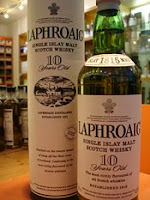 Laphroaig 10 years old
This is one of the most widely available and best selling whiskies in the world. It sells more than any other single bottle of Islay whisky and is a whisky icon with it's green bottle and black and white simple label and tube. This is bottled at 40% ABV and is golden amber in colour. The nose just blows you away. No other drink in the world has the type of smoky characteristics that the Islay malts have and this is a classic example. This is full of rich, sweet peaty smoke (imagine green moss and earth) and these are mixed with a salty note (that reminded me of seaweed or sea air). The palate is rich as well with that intense smokiness (a bit more like a bonfire now) and saltiness revealing more sweetness underneath (think of honey and caramel). It is so intense that it has an almost antiseptic quality on your tongue (this is caused by the high phenol levels in the malted barley) and there is a bitterness right at the end (like iodine). Both of these are classic Laphroaig characteristics. The finish is long with that smoke, peat, earth and bitterness lingering on and on. This is a great example of an Islay whisky, although they are not to everyone's taste. This should cost anywhere between £20-30 depending on how lucky you are.
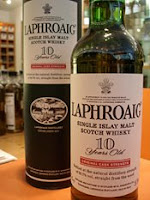 Laphroaig 10 years old cask strength
This is the even more intense sibling of the 10 years old. Bottled at 55.7% ABV, this whisky consistently wins worldwide awards but is less popular due to it's strength. The nose is very earthy and peaty (think of damp moss) and the smokiness reminds of the embers of a bonfire. There is a medicinal note (imagine antiseptic) that joins a salty seaside character. This sounds a strange mixture but they marry together very well. However, this style of whisky is an acquired taste. This attacks your palate with a sensuary overload. There is sweet vanilla and malted barley, honey, caramel and dried fruit (like sultanas) all of which battle with the luscious and intense smoky and peaty flavours. Upon adding water, these mellow slightly and allow a salty note and something bitter through, that reminded me of tobacco leaves. The finish is very long, savoury, complex and very smoky and earthy. This whisky is definately not for the faint hearted! A bottle should cost £40-45.
Prince Charles issued a royal warrant to the distillery in 1993 as it was one of his favourite whiskies and as a result they can display the Prince of Wales crest on their bottles. The core range consists of two 10 year olds (one of which is cask strength), a 15 years old, a 25 years old and a quarter cask (which is matured in smaller casks). Other limited bottlings are released occasionally but are normally pricy. Independent bottlings are readily available and represent good value. Here are the two 10 year olds.
 Laphroaig 10 years old
This is one of the most widely available and best selling whiskies in the world. It sells more than any other single bottle of Islay whisky and is a whisky icon with it's green bottle and black and white simple label and tube. This is bottled at 40% ABV and is golden amber in colour. The nose just blows you away. No other drink in the world has the type of smoky characteristics that the Islay malts have and this is a classic example. This is full of rich, sweet peaty smoke (imagine green moss and earth) and these are mixed with a salty note (that reminded me of seaweed or sea air). The palate is rich as well with that intense smokiness (a bit more like a bonfire now) and saltiness revealing more sweetness underneath (think of honey and caramel). It is so intense that it has an almost antiseptic quality on your tongue (this is caused by the high phenol levels in the malted barley) and there is a bitterness right at the end (like iodine). Both of these are classic Laphroaig characteristics. The finish is long with that smoke, peat, earth and bitterness lingering on and on. This is a great example of an Islay whisky, although they are not to everyone's taste. This should cost anywhere between £20-30 depending on how lucky you are.
 Laphroaig 10 years old cask strength
This is the even more intense sibling of the 10 years old. Bottled at 55.7% ABV, this whisky consistently wins worldwide awards but is less popular due to it's strength. The nose is very earthy and peaty (think of damp moss) and the smokiness reminds of the embers of a bonfire. There is a medicinal note (imagine antiseptic) that joins a salty seaside character. This sounds a strange mixture but they marry together very well. However, this style of whisky is an acquired taste. This attacks your palate with a sensuary overload. There is sweet vanilla and malted barley, honey, caramel and dried fruit (like sultanas) all of which battle with the luscious and intense smoky and peaty flavours. Upon adding water, these mellow slightly and allow a salty note and something bitter through, that reminded me of tobacco leaves. The finish is very long, savoury, complex and very smoky and earthy. This whisky is definately not for the faint hearted! A bottle should cost £40-45.
Tuesday, May 27, 2008
Have just tried ... Ardmore 'Traditional Cask'
 Ardmore is a Highland distillery near Aberdeen and is unusual as they use peated malt for their core range of whisky. Other highland and Speyside distilleries do this, but only for limited releases or batches to supplement their regular range (most notably Benriach, Benromach and Tomintoul). The phenol level is around 14ppm, making the final spirit much less smoky than whiskies from Islay or some of the other islands. The distillery is owned by Jim Beam Global and most of the 5 million litres of whisky produced each year goes to their flagship blend, Teacher's Highland Cream (one of the biggest selling blended whiskies in the UK). This 'Traditional Cask' was originally for export and duty free only but has just been released to UK retailers with the name deriving from the fact that the whisky is matured for some part in small casks that are a quarter of the size of a regular cask. . Other bottlings are few and far between, mostly coming from independent companies.
On the nose, this smells pretty good with the smokiness being quite meaty (like smoke from a barbeque) and sweet (it reminded me of fresh fruit, pears especially). On the palate, there is a similar initial sweetness and maltiness however this is quickly engulfed by the smoke. This feels thin in the mouth and the finish is short, both of which are quite different for a smoky whisky. Overall I was a bit disappointed as it was pretty one dimensional. It was all smoke and not much else. At £25-£30, it is up against some of the smoky big boys (Ardbeg 10 years old, Laphroaig 10 and Bowmore 12) but would be a decent choice if you were looking for something a bit more unusual.
Subscribe to:
Posts (Atom)