Showing posts with label glenburgie. Show all posts
Monday, January 22, 2018
Review - The Ballantine's Single Malts
The blended Scotch brand have entered the single malt category with the release of three whiskies. These are from three of the most important distilleries that contribute single malt to the Ballantine's blended range - Glenburgie, Glentauchers and Miltonduff. All are from the Speyside region and bottled at 15 years of age. They are each presented at 40% ABV and will be available in Asia through travel retail, before seeing a global domestic market introduction. The price will be £42 ($56 US) each.
Thursday, August 11, 2011
Have just tried > Glenburgie 10 years old from Gordon & MacPhail
Glenburgie (pronounced glen-burg-ee) is a little known distillery located in the Speyside whisky region of Scotland. It sits just off the main Aberdeen-Inverness road, between Forres and Elgin. Glenburgie was founded in 1810 by William Paul and was originally named Kilnflat - it was renamed as Glenburgie in 1878. The current owners are Chivas Brothers, part of the larger Pernod Ricard group, and they took control in 2005. The whisky produced at the distillery is one of the major single malts used in their famous and best selling Ballantine’s blended whisky range. Glenburgie has been one of the main single malts used in Ballantine’s since 1935, when the brands owners purchased the distillery so as to secure a regular and consistent supply.
There are no official bottlings of Glenburgie released by the distillery and there are only very occasional releases from independent bottling companies. Therefore the chance to try any Glenburgie single malt is rare. This bottling is released by the award winning independent bottler Gordon & MacPhail and has been matured in a combination of first fill and re-fill ex-sherry casks. It has a strength of 40% ABV and we purchased a 35cl half bottle, which cost around £15. A full 70cl bottle is available for £25-30. It is available from selected specialist whisky retailers.
Gordon & MacPhail are a company based in the city of Elgin. They still operate from their original premises that were constructed when the company was set up by James Gordon and John Alexander Macphail in 1895. They started off bottling whisky for the numerous local distilleries and also some blending and vatting. Business grew rapidly and they were soon joined by John Urquhart, whose family still own and manage the company today. Gordon & Macphail are one of the largest independent bottlers in Scotland, with over 300 own bottlings in their catalogue. Whiskies are selected from numerous distilleries around Scotland and released in a number of ranges. They also own the Benromach distillery in nearby Forres.
Our tasting notes
The colour is golden yellow and the nose is lovely, interesting and immediately inviting. There is a strong initial aroma of fudge-like sweetness with some vanilla, honey and robust oak underneath. With time in the glass, further refined aromas appear - think of hazelnut praline, dried grasses/hay, butter shortbread and hints of orange oil and sultana. On the palate, this feels creamy and lightly oily. The sweetness again comes first with honey and vanilla particularly prominent. Notes of buttery shortbread and hazelnut praline add to the feeling of creaminess in the mouth. Then comes a slightly tangy, slightly astringent yet pleasant hit of oak and wood spice (imagine wood shavings mixed with cinnamon and the tiniest hint of ginger), which dries and cleanses the palate well. Underneath are delicate notes of coconut, cereal grains, orange oil and hay. The balance is spot on with the sweet, bittersweet and spiced wood elements complimenting each other superbly. The finish is dripping with honey-like sweetness but turns more bittersweet and oaky as it fades from your taste buds. There is a final hit of coconut at the death.
What's the verdict?
This is an outstanding whisky and one which demonstrates perfectly the standards that can be achieved by an independent bottling company through the sympathetic use of quality casks for maturation. Gordon & MacPhail are one of the few independent bottlers who send their own casks to be filled at the distilleries and they pride themselves on the quality of the oak that they source and use for their casks. When you taste a whisky like this, it makes you wonder why single malt from a little known distillery (in this case Glenburgie) is not more widely available. This one is worth searching out - it's delicious and a bargain!
There are no official bottlings of Glenburgie released by the distillery and there are only very occasional releases from independent bottling companies. Therefore the chance to try any Glenburgie single malt is rare. This bottling is released by the award winning independent bottler Gordon & MacPhail and has been matured in a combination of first fill and re-fill ex-sherry casks. It has a strength of 40% ABV and we purchased a 35cl half bottle, which cost around £15. A full 70cl bottle is available for £25-30. It is available from selected specialist whisky retailers.
Gordon & MacPhail are a company based in the city of Elgin. They still operate from their original premises that were constructed when the company was set up by James Gordon and John Alexander Macphail in 1895. They started off bottling whisky for the numerous local distilleries and also some blending and vatting. Business grew rapidly and they were soon joined by John Urquhart, whose family still own and manage the company today. Gordon & Macphail are one of the largest independent bottlers in Scotland, with over 300 own bottlings in their catalogue. Whiskies are selected from numerous distilleries around Scotland and released in a number of ranges. They also own the Benromach distillery in nearby Forres.
Our tasting notes
The colour is golden yellow and the nose is lovely, interesting and immediately inviting. There is a strong initial aroma of fudge-like sweetness with some vanilla, honey and robust oak underneath. With time in the glass, further refined aromas appear - think of hazelnut praline, dried grasses/hay, butter shortbread and hints of orange oil and sultana. On the palate, this feels creamy and lightly oily. The sweetness again comes first with honey and vanilla particularly prominent. Notes of buttery shortbread and hazelnut praline add to the feeling of creaminess in the mouth. Then comes a slightly tangy, slightly astringent yet pleasant hit of oak and wood spice (imagine wood shavings mixed with cinnamon and the tiniest hint of ginger), which dries and cleanses the palate well. Underneath are delicate notes of coconut, cereal grains, orange oil and hay. The balance is spot on with the sweet, bittersweet and spiced wood elements complimenting each other superbly. The finish is dripping with honey-like sweetness but turns more bittersweet and oaky as it fades from your taste buds. There is a final hit of coconut at the death.
What's the verdict?
This is an outstanding whisky and one which demonstrates perfectly the standards that can be achieved by an independent bottling company through the sympathetic use of quality casks for maturation. Gordon & MacPhail are one of the few independent bottlers who send their own casks to be filled at the distilleries and they pride themselves on the quality of the oak that they source and use for their casks. When you taste a whisky like this, it makes you wonder why single malt from a little known distillery (in this case Glenburgie) is not more widely available. This one is worth searching out - it's delicious and a bargain!
Tuesday, April 26, 2011
Distillery visit > Glenburgie
Glenburgie (pronounced glen-burg-ee) is a distillery located in the Speyside whisky region of Scotland. It sits just off the main Aberdeen-Inverness road, outside of the town of Forres. The current owners are Chivas Brothers, part of the larger Pernod Ricard group, and they took control of Glenburgie in 2005. The whisky produced at the distillery is one of the major single malts used in their famous Ballantine’s blended whisky range. Ballantine’s is the second best selling whisky brand in the world, behind the Johnnie Walker range, and sells a staggering 70 million bottles a year! Glenburgie has been the ‘signature’ single malt used in Ballantine’s since 1935, when the brands owners purchased the distillery so as to secure a regular and consistent supply.Glenburgie was founded in 1810 by William Paul and was originally named Kilnflat. However, the production of whisky did not officially start until 1829 when Kilnflat was granted a license. The distillery was renamed Glenburgie-Glenlivet in 1878 by Charles Hay, who had reopened it following a period of closure. Glenburgie has changed ownership a number of times since then, including Hiram Walker and Allied Lyons which were later taken over by the Pernod Ricard group. A major refurbishment of the distillery took place in 2004, with the only original parts remaining being the Old Customs House (which is now a tasting facility) and some of the warehouses.
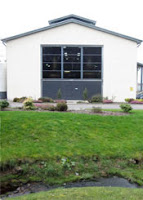
Our visit to Glenburgie was hosted by Alex Robertson, the International Brand Ambassador for Chivas Brothers. We began on a massive expanse of lush lawn in front of the distillery, where Alex gave us a brief introduction to the distillery including a few facts and figures detailed above. This is followed by a walk over to one of the water sources nearby. In this tranquil spot, Alex explained that the water used at Glenburgie is taken from five sources - it either rises from local springs and flows in a number of small streams to reach the distillery (as pictured, left) or comes via a borehole close by.
Alex then moved us inside the distillery in to a small welcoming hall, which shows the six bottles in the current Ballantine’s range – the Finest and Limited, plus the four age statements of 12, 17, 21 and 30 years old. We have recently written a post detailing the Ballantine's range - click here to read this. He then takes us upstairs, via the Porteus mill which remains from the original distillery, to a large room with impressive views of the surrounding countryside. Here, it is explained to us about the different strains of barley that are used and what they look for to give the required characteristics to their whisky.
On moving back downstairs, we were greeted by Neil Corbett - the Distillery Manager of Glenburgie. Neil is an Englishman from the West Midlands, who learned his trade in the brewing industry. He went on to walk us around the interior of the distillery, which is housed on one level in one massive space, beginning with the mash tun. This is where warm water is added to the milled barley (known as grist) and the soluble sugars are extracted. The final sugary liquid is called wort. At Glenburgie, the copper domed mash tun can hold 7.5 tonnes of barley and after a five hour cycle, this will yield approximately 35,000 litres of sugary wort. This liquid then moves on to the fermentation stage, as do we.
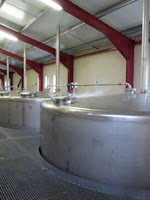
Neil took us through to see the washback tanks - these are the large vessels in which the fermentation process takes place. Glenburgie has 12 such tanks and were all new at the time of the renovation. They are made of stainless steel and each tank is at a different stage of Glenburgie's 52 hour fermentation cycle. Liquid yeast is added to the sugary wort and it then gets to work on turning all of the soluble sugars in to alcohol. This process generates plenty of heat and carbon dioxide, giving this area a slightly unpleasant feel. Once the cycle is complete, the result is a strong beer-like liquid with an alcoholic strength of approximately 8% ABV - this is called 'wash' and it is this which progresses to the distillation stage.
Four of the stills in Glenburgie's impressive still room have been kept from the old distillery, with the addition of two further stills. These six stills produce 2.6 million litres of spirit per year, all of which is destined for blending. The distillation is completed in two parts. The first part is where the wash is heated and distilled in a wash still and produces a final liquid with an alcoholic strength of 28-30% ABV. The second sees this liquid distilled again and the desirable part or 'cut' (at most distilleries this is around the 65-70% ABV mark) is then collected. It is this final 'cut' which is put in to wooden casks and matured to become whisky. The still room at Glenburgie is very impressive, as indeed is all of the facility, and it has another interesting feature - thermal compressors are attached to the condensers on the lyne arms. This makes Glenburgie one of the most highly energy efficient distilleries in the Scottish industry as much of the heat from the condensation stage of distillation is recycled and put back in to the system.
The majority of the spirit produced at Glenburgie is filled to ex-bourbon casks for maturation so as to create that 'signature' malt whisky for the Ballantine's blended range. The site is home to four dunnage warehouses (the traditional type with stone walls and earth floors), plus four other racked/palletised ones. The remainder of the stock is matured at other sites which are owned by Pernod Ricard and are dotted around the Speyside region. After a quick walk around one of the dunnage warehouses with Alex, we are taken to the Old Customs House for a whisky tasting and further information about the Ballantine's brand with Sandy Hyslop - the Master Blender of Ballantine's for Chivas Brothers. Click here to read our recent post covering this session.
We thought that we would share some of the sights and sounds of Glenburgie with you, plus insight and facts from Alex and Neil, in the film below. We hope that you enjoy watching and seeing inside a little known but very important distillery, which is not open to the public. We thank Alex, Neil and Sandy for their hospitality, time, information and for making our visit to Glenburgie so enjoyable and memorable.
labels:
alex robertson,
ballantine's,
chivas brothers,
glenburgie,
pernod ricard,
speyside
Sunday, April 3, 2011
A trip to Speyside > March 2011

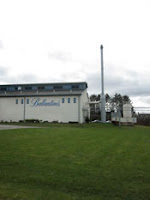
At the end of last month we were delighted to be invited on a mini tour of the Speyside whisky region by Chivas Brothers. The company, which forms part of the larger Pernod Ricard group, owns 12 distilleries in total, 11 of which are located in Speyside. Our tour was to visit three of them - Glenburgie (pronounced glen-burg-ee and pictured, above left), The Glenlivet (pictured, above centre) and Strathisla (pronounced strath-eye-la and pictured, above right). The three distilleries are the foundation on which Chivas Brothers is built - Glenburgie single malt contributes greatly to the famous Ballantine's blended whisky range, Strathisla likewise for the Chivas Regal blended range and The Glenlivet is a world famous and iconic single malt whisky in its own right.
On the trip we learnt plenty about each of the three distilleries and the Chivas Brothers' organisation and methodology. We met a number of people who spoke to us about the nuances of the whisky industry - these included Alex Robertson (the International Brand Ambassador for Chivas), Sandy Hyslop (the Master Blender of Ballantine's) and Alan Winchester (the Chivas Distillery Manager, who oversees The Glenlivet amongst other distilleries). All imparted a great deal of information and enthusiasm in the short time that we spent with them. We would like to take this opportunity to thank them again for their time. We will be writing about the trip and our findings over the coming weeks in a series of blog posts.
We were joined on the trip by a mix of old and new whisky blogging friends, including our fellow Londoners Joel and Neil from Cask Strength, Chris from Edinburgh Whisky Blog, Jim and Nicola from Whisky Boys and Patrick from Whisky-News, a whisky website which he writes in both English and French. If you are not aware of these sites, then we urge you to visit them as all are very good and are packed with information. They will also be writing about the trip, so please follow their versions of events too.
We would also like to thank Courtney (the Chivas Communications Executive) and Grace and Kaye from Richmond Towers, who do PR for Chivas Brothers, for all the organisation and additional information given. Final mention must go to 'Willie', the bus driver who ferried us around in the minibus for two days and had no sympathy for all our 'morning of Day 2' hangovers - this manifested itself in him driving as fast as possible through the Scottish countryside, finding every pothole and accelerating towards every corner! Maybe, it just felt worse than it actually was .....
labels:
chivas brothers,
glenburgie,
glenlivet,
pernod ricard,
speyside,
strathisla
Friday, February 12, 2010
New releases ... Scotch Malt Whisky Society - February 2010
A worldwide clubThe Scotch Malt Whisky Society is a members club devoted to bottling single casks of whisky. The Society is UK based and has two members rooms in Edinburgh and London. There are also now offices spreading around the world and these currently include America, Australia, Japan and throughout Europe. Their collection of whiskies is extensive and ever growing. A panel of members select the whiskies from exclusive casks and these are then bottled and released at regular intervals throughout the year. You can join the club and check out their exclusive range of whisky at www.smws.co.uk.
Different labelsThe Society has a unique label system that uses numbers rather than naming the distillery. For example, something labelled as 24.108 has 24 being the Society's number ID for the distillery and 108 being the number of casks bottled by the Society from that distillery. They do this to prevent any positive or negative prejudice that a consumer may have against a certain distillery. They provide comprehensive tasting notes and these are compiled by a tasting committee that discuss the merits of each bottling. The notes can often be curious and very creative! We were lucky to be invited to a tasting evening at the Society's London offices this week, where we sampled some of the whiskies from the new February releases. Thank you to Darren Rook for an excellent evening.
Our tasting notes
Cask 99.11 (Glenugie 29 years old)
Whisky from this distillery is scarce and the SMWS has not released any Glenugie for years, so to get the opportunity to taste some was a rare treat. Glenugie (pronounced glen-oogee) was located in the coastal Highland town of Peterhead, to the north of Aberdeen, and was closed in 1983. The colour is golden yellow and the nose is full of cereal grains and vanilla. These are joined by floral (think of heather) and herbal notes (imagine dried grasses and straw). The palate is very grainy and buttery and is reminiscent of Scottish oatcakes (this characteristic increases the longer the whisky is in the glass). Also present are vanilla, dried grasses and spice (think of nutmeg). The initial sweetness turns drier with a bitter edge. The finish is short, dry and light. An acquired taste but one that grew on us with time. 43.4% ABV/192 bottles/£78
Cask 119.12 (Yamazaki 16 years old)
This cask has only been released to the American, Australian and Japanese Society members. Yamazaki is Japan's oldest whisky distillery and was founded in 1923. The colour is rich golden amber and the nose is promising but has a distinct acetone note (think of nail varnish remover). There are a number of sweet notes present - caramel, raisins, dried peaches, dark sugar. The palate is note as sweet and offers a complex mix of flavours - candied orange, raisins, prunes, hints of liquorice and nutmeg - and is reminiscent to fruit cake and brandy. the finish is long, dry and slightly astringent and is full of spices and tannin. The addition of water softens this. A lovely dram. 54% ABV/262 bottles/no UK price available
Cask 22.28 (Glenkinchie 21 years old)
Glenkinchie is a Lowland single malt and the nearest distillery to Edinburgh. The colour is pale gold and the nose is light and fresh. There is distinct grassy notes (think of dried grass or hay) and these join with vanilla and fresh green apple aromas. On the palate, this whisky is light and inoffensive and offers an initial hot alcoholic burn. When this fades, other notes come through - vanilla, cereal grains, butterscotch and citrus (imagine lemon zest). The finish is short and crisp. The addition of water brought out some citrus on the nose (that lemon zest again) and more grains and dried grass on the palate. 54% ABV/223 bottles/£63.50
Cask 7.55 (Longmorn 40 years old)
Longmorn is a little known but well renowned distillery that lies close to the city of Elgin in the Speyside region. We don't get the chance to sample 40 years old whiskies often, so this was a real treat. The colour is orange amber and the nose is rich and sumptuous. There are plenty of aromas here - dark sugar, treacle, dried fruits, orange peel, cocoa, espresso coffee, waxy furniture polish and a hint of leather. WOW! The palate does not disappoint and is silky smooth, intense and rich. First comes orange marmalade and dried fruits and is followed by leather, cocoa and coffee. There are also minty, eucalyptus and liquorice notes. The finish is long and gorgeous. This has a dessert wine/Cognac feel and is a lovely complex whisky. 54.9% ABV/451 bottles/£186 (a great price for a 40 years old whisky!)
Cask 53.139 (Caol Ila 27 years old)
Caol Ila is located on the famous whisky island of Islay and they produce whiskies in the smoky style. The colour of this whisky is golden yellow and the nose is smoky, sweet and fresh. There is a delightful combination of aromas - sweet earthy peat, vanilla, candy floss, salty brine and something fishy (others in the group suggested anchovy). On the palate, this has a complex mix of notes - sweet vanilla, cereal grains, dried grasses, damp moss, slightly acrid bonfire smoke, salty brine, lemon zest and spicy chilli peppers. The finish is long with the peat smoke lingering for ages. It is light and fresh for something of this age and drinks well without water, despite its ABV strength. With water, more vanilla, grass and burning bonfire come out. An absolute cracker of a dram. 55.5% ABV/256 bottles/£82
Cask 33.80 (Ardbeg 11 years old)
Ardbeg is also located on the western island of Islay and the current insatiable thirst for their whiskies has seen this bottling sell out in just three days! Therefore, the only place to try it is at the SMWS rooms in Edinburgh or London. The colour is golden yellow and the nose is pungent and fresh. There is plenty of smoke here (a combo between bonfire ember and damp soil) and some citrus (think of lemon zest), salt, seaweed and vanilla. On the palate, this feels even smokier (especially the peaty/soil element) and feels oily and buttry in the mouth. Other notes include vanilla, caramel, grass and bitter iodine. The finish is very long and peaty. Water brings out more sweetness and this is balanced by more salt and iodine. 56.6% ABV/242 bottles/£55.50
Dram of the night > a difficult choice but the Caol Ila 27 years old.
labels:
ardbeg,
caol ila,
cask strength,
glenburgie,
glenkinchie,
longmorn,
scotch malt whisky society,
single cask,
smws,
yamazaki
Tuesday, May 5, 2009
Have just tried ... Linkwood 26 years old & Glen Craig 34 years old from The Scotch Malt Whisky Society
On our recent tasting evening at the London headquarters of The Scotch Malt Whisky Society, we sampled another couple of whiskies in the members’ bar. The Scotch Malt Whisky Society is a members club that bottle single casks of whisky from distilleries all around the world. The majority are from Scotland with 126 distilleries represented. They use a numbering system for their labelling, rather than naming the distillery. In this system, the first number is the distillery ID and the second is the number of the cask that has been bottled from that distillery (for example, using one of the whiskies below – 39 is the distillery ID for Linkwood and 69 represents the 69th cask that the Society have bottled from Linkwood). We randomly picked two distillery numbers and this is what we got …39.69 Linkwood 26 years old
Linkwood is a distillery from the Speyside region of Scotland. The distillery was founded in 1821 and is located in the town of Elgin. It is currently owned by drinks giant Diageo and they use most of the whisky produced at Linkwood for blending, especially in Bell’s which is one of the UK’s best sellers. Only about 2% of the annual two million litres of whisky produced there gets released as single malt. The colour is golden and the nose is light yet fragrant. There is lots of vanilla, caramel and herbal notes (think of dried grasses and leaves). On the palate, this feels thick and quite syrupy in the mouth. The caramel becomes more toffee/butterscotch-like and the grassiness is particularly prominent. This is counteracted by a zingy citrus note (imagine lemon zest) and results in a refreshing feeling. The finish is complex and reasonably long with the vanilla and malted barley cereal coming through. Finally, this becomes quite dry, tannic and woody but this is not unpleasant.
104.11 Glen Craig 34 years old
Glen Craig is a very rare single malt whisky that was produced at the Glenburgie distillery between 1958 and 1981. Glenburgie is a Speyside distillery that can be found between the towns of Elgin and Forres. It is currently owned by Pernod Ricard, who use it in their popular Chivas Regal blends. Some also goes to other best selling blends, such as Ballantine’s and Teacher’s. Less than 1% of the four million litres produced there every year gets released as single malt, with the only way to buy it being through independent bottling companies. Glen Craig was an experimental single malt developed in the late 1950s and produced using Lomond stills – a type of still that could produce differing styles of whisky by adjusting its components. Production was stopped when these Lomond stills were dismantled and the whisky is now extremely rare.
The colour is a rich dark gold and the nose is very unusual. It is very fragrant and floral (imagine a cross between a feminine perfume and a spring meadow!), with some gorgeous sweet vanilla and cereal grains underneath (think of a digestive biscuit). This nose just made you want to try it and on the palate this is creamy and full bodied. The sweet vanilla and malted barley are there again and are joined by a complex mix of caramel, warm spice (think of nutmeg), tropical fruit (imagine pineapple and mango) and that fragrant floral note (think more of roses this time – sounds odd I know, but its true!). The finish is long, sweet and enjoyable with a hint of nuttiness coming through at the end (imagine a bitter style of nut like a walnut).
Subscribe to:
Posts (Atom)

