

Showing posts with label burn stewart distillers. Show all posts
Showing posts with label burn stewart distillers. Show all posts
Friday, September 11, 2015
Inbox - The Week's Whisky News (September 11, 2015)


Friday, May 15, 2015
Inbox - The Week's Whisky News (May 15, 2015)
Sunday, March 3, 2013
Have just tried – Bunnahabhain 40 Years Old

Tuesday, September 8, 2009
Have just tried ... Bunnahabhain Toiteach
 Bunnahabhain (pronounced bunna-ha-ven) is located in the northern part of Islay, the famous whisky producing island which lies off the west coast of Scotland. The distillery produces the lightest of the all the Islay single malt whiskies with extremely low levels of peat influence compared to most of the other distilleries on the island, which is famous for it smoky and peaty whisky. Bruichladdich is the only other Islay distillery that produces the majority of its single malt whisky in a non peated style. This Toiteach (meaning 'smoky' in Gaelic and pronounced as toc-chach) is a new limited edition exception to this rule. It is made with heavily peated malt and is bottled at 46% ABV and with no age stated.
Bunnahabhain was founded in 1881 and the current owners are Burn Stewart Distillers. The distillery produces 2.5 million litres per year and much of this goes towards the popular Black Bottle blend, which contains whisky from seven of Islay’s eight working distilleries but has Bunnahabhain as its base. The core range of single malts has three whiskies - a 12 years old, this 18 years old and a 25 years old. Bunnahabhain is a favourite amongst the independent bottling companies and through these you can occasionally also pick up some peaty expressions from the distillery.
The Toiteach is a light golden colour with a robust, aromatic nose. It is very peaty but the smokiness has an acrid edge that is reminiscent of burning rubber. This becomes earthier the longer the whisky is in the glass. There is also a distinct sweetness (think of caramel) that combines pleasantly with the smoke, although this is tempered by a prickly alcohol burn. On the palate, there is an initial sugary hit (imagine caramel again and honey) and then the acrid peaty smokiness kicks in (still a bit rubbery, like elastic bands). Other elements present include some dried fruits (imagine sultanas especially), some vanilla and malty cereal grains (this note is slightly bitter, like the grain husks), a salty tang (think of sea water or brine) and a warm spicy note (imagine white pepper). However, these struggle against the powerful smokiness. The finish is warming and robust with some noticeable alcohol burn. It starts sweetly with a touch of saltiness before becoming very smoky (a bit more peaty now, rather than rubbery) and pretty dry and woody.
The Toiteach is an interesting whisky, as it shows a different side to the traditional whisky from Bunnahabhain. It shows potential but the problems are its youthfulness and the fact that the smokiness tends to overpower almost everything else. The result is slightly unbalanced. It would be interesting to see how this whisky changes with a longer maturation period, where more would be drawn from the cask and the youthful alcohol and smokiness would mellow. An interesting experiment none the less and well worth a try, even if it is just for curiosity's sake. It is available from limited whisky retailers for £45-50 a bottle.
Friday, August 14, 2009
Have just tried ... Tobermory 10 years old
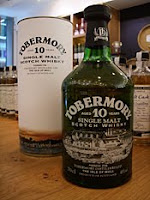 Tobermory is the only distillery on the island of Mull, which lies a short ferry ride from the west Highland coast of Scotland. It was founded in 1798, making it one of Scotland's oldest distilleries and is named after the small town of Tobermory on the island. Tobermory is small and compact with an annual production capacity of one million litres and is currently owned by Burn Stewart Distillers. The whisky produced there is popular with blenders and this means that only around 15% of Tobermory's whisky is released as single malt. The most popular blended whisky that uses Tobermory is Scottish Leader.
The distillery's original name was Ledaig (pronounced ley-jeg and translating as 'safe harbour' from Gaelic). The history of the distillery is littered with periods of closure for one reason or another, with the two most significant being 1837-1878 and then 1930-1972. Following another sporadic period of production, the Tobermory Distillers Ltd. was set up in 1979 and they changed the distillery's name from Ledaig to Tobermory. However, they were soon in financial trouble and sold off some of the outbuildings and warehouses to developers and these were converted to apartments. Burn Stewart then took control in 1993, buying the distillery and all the old maturing whisky stock.
Tobermory produce three different styles of single malt whisky at the distillery. The majority is produced in the unpeated style and is called Tobermory. There is also a lightly peated version which is sold as Ledaig and a heavily peated version called Iona (named after a small island that neighbours Mull and the whisky is only available from the distillery shop). This 10 years old is available in larger supermarkets and specialist whisky retailers and can be priced anywhere between £20-25 (sometimes even cheaper if one of the big supermarket chains have it on promotion). It forms part of the Tobermory core range which also includes two more limited editions at 15 and 32 years old.
Friday, May 15, 2009
Have just tried ... Bunnahabhain 18 years old
 Bunnahabhain (pronounced bunna-ha-ven) is located in the northern part of Islay, an island which lies off the west coast of Scotland. The distillery produces the lightest of the all the Islay single malt whiskies with extremely low levels of peat influence compared to most of the other distilleries on the island. Islay is famous for it smoky and peaty whisky and Bunnahabhain the black sheep of the family. Bruichladdich is the only other Islay distillery that produces the majority of its single malt whisky in a non peated style. Bunnahabhain was founded in 1881 and has endured a turbulent history and a number of closures and part closures. The most recent of these was between 1999 and 2002 when it was closed for the summer months due to poor availability at its local water source.
The current owners are Burn Stewart Distillers and the distillery produces 2.5 million litres per year. Much of this goes towards the popular Black Bottle blend, which contains whisky from seven of Islay’s eight working distilleries but has Bunnahabhain as its base. The core range of single malts has three whiskies - a 12 years old, this 18 years old and a 25 years old. Bunnahabhain is a favourite amongst the independent bottling companies and through these you can occasionally also pick up some peaty expressions from the distillery.
The colour is a golden burnt amber with a nose that needs a couple of minutes to open up fully. To begin with it seems quite flat and one dimensional but becomes rich with a lovely sweetness (imagine a combination of dried fruits, especially raisins, and caramel) and an interesting saltiness (think of brine or seawater). In the mouth this feels creamy with a distinct buttery quality. It is rich yet fresh with a mixture of the fruit, brine and caramel elements from the nose and some sweet (almost sugary) cereal grains, a spicy note (think of nutmeg) and a hint of pleasant bitter woodiness (sounds odd but imagine waxy furniture polish). The finish lingers on and on and is much drier, woodier and saltier than the nose or palate.
This Bunnahabhain 18 years old is only released in 1500 bottle batches so is harder to find than the 12 years old. It is a nice rich and fruity whisky with the interesting salty twist. If you can find a bottle, it should cost around £50 and is pretty good value for that price.
Thursday, May 14, 2009
Have just tried ... Black Bottle
 Black Bottle is a blended scotch whisky. It is unique as it contains single malt whiskies from seven out of the eight distilleries on the famous whisky producing island of Islay. These are combined with a number of grain whiskies to produce the blend. Islay is famous for its smoky, peaty whiskies and can be found off the south western coast of mainland Scotland. The seven distilleries included in Black Bottle are Ardbeg, Bowmore, Bruichladdich, Bunnahabhain, Caol Ila, Lagavulin and Laphroaig. The exception is the new distillery Kilchoman which is small and has only been in production for a couple of years.
The brand is currently owned by Burn Stewart Distillers and the blending of Black Bottle is based at Bunnahabhain (pronounced bunna-ha-ven), its only distillery on Islay. It was first blended in 1879 by a company called Gordon Graham & Co (whose name still appears on the bottle and cap) and got its name as it was originally filled in to bottles made from black German glass. This was changed to the green bottle in 1914, due to the outbreak of the First World War and the boycotting by many companies of German products.
The colour is light and golden with an intriguing nose. It feels fresh with some dried fruit (think of sultanas), sweet vanilla, some cereal grain notes and a powerful whiff of peaty smokiness (imagine damp, freshly dug soil). On the palate, this is again light and refreshing with an interesting mixture of three main elements - sugary caramel immediately on the tongue then earthy smoke and gorgeous vanilla. Other notes that come through are some further sweetness (think of honey) and a strange hint of spice (reminding me of cloves). The finish is long with a herbal grassy note (think of dried grasses) joining the sweet cereals and vanilla, with the smokiness burning away and fading gradually.
Black Bottle is an extremely well rounded and enjoyable whisky. It is smoky but not a smoky as expected, considering a number of the world's smokiest whiskies are included in the blend. The balance between the non smoky single malts, the grain whiskies and the smoky ones is very good and gives a surprisingly light refreshing feel at all stages of tasting. An excellent dram, especially considering it only costs around £15 a bottle, and one of the best smoky blends that I have tried to date.
Tuesday, February 17, 2009
Have just tried ... Scottish Leader
 Scottish Leader is a blended whisky that first appeared on the market during the 1940s. The brand is currently owned by Burn Stewart Distillers and they use single malt from their Deanston and Tobermory distilleries to form the foundation of the blend. This is then blended with other grain whiskies to produce the final blend. As with many blends, there is no age stated and this can indicate that there is some young whisky present (in a blend, if there is an age it legally has to indicate the youngest whisky that has been used). Scottish Leader is one of the biggest selling whiskies in Scotland but few places sell it elsewhere in the UK (The Whisky Shop chain are the main stockists). It is positioned at the cheaper end of the market, costing less than £15 a bottle.
This whisky has a colour of dark reddish amber and the nose is sweet and initially pretty aggressive. There is lots of spirit rawness that attacks your nose hairs but once you get passed this there is sugary caramel and toffee present, some woodiness and maybe just a hint of peaty smokiness. On the palate, things take a similar course. You are immediately hit with raw spirit (this suggests that there is some young whisky in the blend) but again once your mouth gets used to this some more pleasant characteristics come through. That caramel (reminding me of burnt sugar, I think) is present again as is the woodiness (that is almost makes it a little bitter) and the smokiness in the background. There is also lots of malted barley that gives a slightly bittersweet feeling. The finish is fairly short with the lasting characteristic being the raw alcohol spirit. This is a cheap blended whisky and while not being my favourite whisky when drunk straight, I think that it would be a decent whisky to have with a mixer as it has enough interesting elements present. Certainly not too bad for the price.
Thursday, October 2, 2008
Have just tried ... Bunnahabhain 12 years old
 Bunnahabhain (which is pronounced boo-na-ha-ven) is located in the north of the island of Islay, which lies off the west coast of Scotland. The distillery was built in a remote spot due to the quality of the local water source and the village of Bunnahabhain was born as a result. Production began in 1881 and the distillery has had difficult history at times, with numerous owners and three periods of closure (during the 1930s, 1980s and most recently between 1999 and 2002). The current owners are a group called Burn Stewart Distillers and the distillery can produce 2.5 million litres per year. Much of this goes towards the popular Islay blend called Black Bottle, although this is changing as Bunnahabhain's own popularity grows. Bunnahabhain is the lightest of the Islay whiskies with extremely low levels of peat influence in the malted barley (around 1-2ppm) compared to nearly all the other Islay distilleries. Islay is famous for it smoky and peaty whisky and Bunnahabhain is very much the black sheep of the family. The core range has only three whiskies - this 12 years old and two more limited releases, an 18 years old and a 25 years old. Independent bottlings are readily available.
The nose has a lovely fresh sweetness to it, with vanilla and caramel coming through. These are joined by a distinctive saltiness (imagine seaweed or sea air) and this is common in whiskies that are matured by the sea, as Bunnahabhain is. Over time, the porous wood of the casks breathes in the salty sea air and this is transferred to the whisky. On the palate, this is gentle and smooth with lots of malty sweetness and dried fruitiness (imagine sultanas). That saltiness is present, giving the whisky a briny quality, which sounds unappetising but is actually refreshing. There is also something nutty and herbal. The finish is quite short and refreshing with an interesting herbal bitterness. This is completely different from any other whisky from Islay and is worth a try. It should cost between £25-30 a bottle.
Monday, June 16, 2008
Have just tried ... Deanston 12 years old
 Deanston is located to the north of Edinburgh, just above the 'Highland line' (this is an imaginary line that divides the Highland whisky region from the Lowland region). It is a reasonably large and modern distillery, producing 3 million litres per year and opening in 1965. However, the distillery is housed in an old cotton mill and weaving factory and these buildings date back to 1785. Deanston is owned by Burn Stewart Distillers, who are also own two other distilleries – Bunnahabhain on Islay and Tobermory on the island of Mull. The majority of the whisky produced at Deanston goes into various blends that are produced for export to Europe and Asia. This is the only current official bottling from the distillery and it is little known in the UK, but extremely popular in Europe (especially France). Independent bottlings are available but reasonably limited.
This whisky looks pale (think of straw) and the nose smells light and fresh. There is some sweet maltiness (imagine smelling a handful of grain) mixed with fresh grass cuttings and something nutty (it reminded me of the linseed oil that I use on my cricket bat!). There is also a whiff of smokiness. On the palate, it is light and very refreshing, with the malty sweetness and the grassiness from the nose mixing with a more prominent nuttiness (think of walnuts), some citrus notes that give it a bit of zing (imagine lemon zest) and a hint of smoke in the background. The finish is short, crisp and very dry. The citrus and nuts are evident with the herbal grassy note coming in right at the end. This is a pretty good and refreshing and reminded me more of a Lowland whisky (these are normally light, fresh and zesty) than of a Highland. It would be perfect for a hot day or as an introduction for someone who has never tried whisky before. It also sells for a bargain price of around £20 and is well worth a try.
Subscribe to:
Posts (Atom)