Showing posts with label inver house. Show all posts

Thursday, March 1, 2018

Review - Old Pulteney 25 years old


The Old Pulteney 25 years old is a recent super premium addition to the core single malts from the north Highland distillery. This replaces the multi award-winning 21 years old, which won the prestigious Whisky of the Year 2012 in Jim Murray's Whisky Bible, in the range. The new expression has been matured in American oak ex-bourbon barrels for its first 22 years, before being transferred to Spanish oak ex-sherry butts for three years.

Monday, May 13, 2013

New release - AnCnoc 22 years old

The east Highland distillery of Knockdhu have announced a new single malt release in to their core range - the AnCnoc 22 years old.  The new whisky has been predominantly matured in ex-bourbon casks, along with a small percentage of ex-Oloroso sherry casks.  It has been bottled at 46% ABV and is non chill-filtered.  The initial release will see 5,700 bottles appearing in selected markets including Denmark, Germany, Japan, Russia, Sweden, Taiwan, the UK and the USA.  The recommended price is £85 a bottle.

Wednesday, February 20, 2013

Have just tried - AnCnoc Peter Arkle 2nd Edition

Back in the Autumn, we reported that the Highland single malt brand of AnCnoc (pronounced a-knock) had unveiled the second expression in a series created in collaboration with a renowned Scottish illustrator Peter Arkle. The partnership, which launched in April 2012, revolves around a series of limited AnCnoc single malt expressions presented in packaging designed by the artist. Matt T reviewed the First Edition when that was launched last Summer - click here to read his review.

Sunday, December 9, 2012

New release - Balblair 2002

The Balblair 2002 is the latest Vintage to be released by the up-and-coming distillery. The policy of selecting whiskies from particular years, rather than well established age points such as 12, 15 or 21 years old, was started in 2007 and differs from the philosophy of most distilleries.  The whiskies are specially selected from Balblair's maturing stock by distillery manager John MacDonald and listening to him speak at a recent event he made one telling statement - "our whisky tells us when it's ready, not the other way round".  We liked that ...

Wednesday, March 14, 2012

New release - AnCnoc 1998 Vintage

The increasingly popular single malt brand of AnCnoc (pronounced a-knock), have announced a new release in their growing line of Vintage expressions. This one was distilled in 1998 and has been matured in a combination of ex-bourbon and ex-sherry casks. There are only 5,100 bottles and the whisky is being released at 46% ABV and non chill-filtered. It is just appearing now in specialist whisky retailers in selected markets - France, Germany, Japan, Russia and the UK. The recommended retail price is £50 a bottle.

The AnCnoc single malts are produced at the Knockdhu distillery. Knockdhu (pronounced nock-doo) lies deep in the rugged countryside of the eastern Highlands, with the closest town being Huntly. The distillery is one of the most traditional in the Scottish whisky industry with no computers to aid production. Everything is controlled by the skills of the distillery workers and Knockdhu produces approximately one million litres of spirit per year.

Knockdhu translates as 'black hill' from Gaelic and the name of the single malts were changed to AnCnoc (simply 'the hill' in Gaelic) in the 1990s, so as to avoid consumer confusion with the similarly named Speyside distillery of Knockando. It was founded in 1893 by a company called Distillers Company Limited (DCL), with production starting in 1894, and it is currently owned by Inver House Distillers. For more information on the brand, go to www.ancnoc.com.

Our tasting notes
The colour is golden yellow and the nose is fresh, vibrant and sweet. There are immediate aromas of crisp green pears and apples, which are quickly joined by strong notes of crumbly brown sugar. With time this obvious sweetness becomes more honey-like and other aromas seem to develop - think of vanilla, malty cereals, cinnamon, some dried fruit (especially sultanas) and a hint of orange zest.

On the palate, this feels initially very soft and velvety, before becoming slightly tangy towards the end - this feeling is driven by the orange zesty note from the nose). There is a combination of elements such as bittersweet, malty cereals, drying wood spices (imagine cinnamon and nutmeg) and sweet vanilla, honey and brown sugar, which all combine and marry together well. There are a number of further characteristics that add some depth and interest - dried fruits (especially some sultanas and raisins, plus dried apple), toasted almonds, toffee, a herbal note which is reminiscent of dried grass and just the faintest, most distant hint of some tobacco-like smoke.

The finish is reasonably long and holds the interest. Firstly, it appears sweet and full of honey, then the tangy, zesty orange note is to the fore, then this becomes increasingly nutty (think of the toasted almonds from the palate again), before it completes its journey with some lovely drying wood spices.

What's the verdict?
This new version of AnCnoc is a lovely single malt and a very good, solid effort from this growing brand. Previous versions have tended to be on the lighter, aperitif side but there is clearly a little more ex-sherry cask influence in this 1998 Vintage which has beefed it up slightly and added some pleasant sweetness. The zesty, tangy notes work particularly well and add complexity. This would be a good choice for a whisky beginner/new single malt drinker, which is one of the audiences that AnCnoc are marketing themselves at.

Thursday, November 17, 2011

Balblair Brand Home Opening


Thursday 3 November 2011 was "a significant date in the history of the Balblair distillery" to quote John MacDonald, the Distillery Manager.  That is saying something when you consider that Balblair is one of the oldest distilleries still in operation in Scotland, having been founded by John Ross in 1790. The date saw not only the launch of a new whisky in to the Balblair core range - the 2001 Vintage - but the 'significant' opening of the new Brand Home was the main event.  The guest list included some very senior people from Inver House Distillers and Thai Beverage (the distillery's owners), and a selection of influential alcohol/whisky journalists and bloggers.  Somehow I got on the trip.

The trip began the day before with an evening meeting at Euston station in London, where the assembled guests joined the overnight sleeper train to Inverness.  Twelve hours and a few bottles of complimentary Balblair single malt later, we awoke in the capital of the Highlands.  There was no hangover, just a nagging dull pain behind the eyes from disturbed sleep in a confined, moving space.  This wasn't helped by the minibus driver who collected us and drove us to the distillery, while trying to break the land speed record and choosing an unorthodox 'cross country' route.  However, it was helped by a welcoming black coffee and bacon sandwich combo upon arrival at Balblair, plus a good lungful of fresh Highland air.

The burn at Balblair
The Balblair distillery is located in the picturesque village of Edderton, near to the town of Tain. It lies close to the shores of the Dornoch Firth, one of Scotland’s largest estuaries, with the Highlands rising up behind, the Inverness-Thurso railway track running next to it on one side, a burn (that's a stream to me and you) to the other and a 2,000 year old Pictish standing stone just a few hundred metres away. The current buildings were all constructed in 1893, when the distillery was moved a few hundred yards to utilise the new railway line. It is a glorious location and one I was pleased to re-visit.

The day began with a tour of the distillery, which was taken by John MacDonald.  He has been the Distillery Manager at Balblair since 2006 and this follows 17 years service down the road at Glenmorangie, where he worked his way up through the ranks to the position of Assistant Manager. He puts his current success at Balblair down to the fact that he has done every job within a distillery – warehouseman, mill-man, mash-man, still-man and then senior management. John's passion for the place is immediately evident and he leads us around the distillery and explains what makes it tick.  Check out the video below for more information and also the notes from our Distillery Visit last year.


The Brand Home shop
Next was a look at the new Balblair Brand Home.  When we visited in November last year, this project was being conceived as an idea.  The facility was much different now to the cold malting floor that we had previously stood in. Upon entering, there is a compact shop and relaxation area selling the range of Balblair whiskies and a few items of branded clothing. I learn later that most of this was decorated and built by John and the staff at Balblair.

Bottle #11
This area also houses a specially selected cask of whisky which visitors will be able to bottle themselves.  It is an ex-bourbon cask from 1992 and will cost £80 a bottle. Each guest was asked to fill their own commemorative bottling to mark the opening - John had the honour of filling Bottle #1, mine was Bottle #11.  These were the first bottles of whisky to ever be filled on the site of Balblair, as all other releases are bottled at other Inver House facilities. Tasting notes of this bottle/cask will follow once we open the bottle!  Watch the video below to see John filling his ceremonial bottle and firstly, explaining about the history of Balblair and facts about the distillery.


Balblair workers on film
Through a doorway is an area that is designed to host corporate events and formal tastings.  This is much larger and is housed what used to be the old malting floor.  Thankfully, this area has been sympathetically restored and many of the original features remain.  It consists of a small bar area on one side, a gallery space featuring photos of distillery workers on the other and a glass sided tasting/meeting room in the centre.  The subdued lighting adds to the ambiance and you can feel the history in the place.

What is refreshing is Balblair's stance towards the new facility.  By naming it as Balblair's Brand Home, rather than as a visitor's centre, they are making a statement.  When talking to John MacDonald and other members of the Inver House team at the opening event, they made it clear that they wanted to attract discerning single malt fans and whisky connoisseurs, rather than the bus loads of tourists which the larger distilleries cater for.  This philosophy seems to fit in well with Balblair's image, ethos, location and size and should be applauded.  It is hoped to be used more as an educational tool about the brand and its vintages, rather than selling high margin goods such as whisky fudge, shortbread and tartan in the gift shop.

The next stage in what was becoming an action packed day was a tasting of the range led by John MacDonald and Andy Hannah, the UK Brand Manager for Inver House.  Here, we were led through a series of the Balblair Vintages, after starting with a sample of the new make spirit which had been produced the previous day.  The samples were accompanied by some snazzy videos showing things that happened in each of the years of each Vintage.  We tried two cask strength samples from 1990 (one peaty cask and one non-peaty), the 1989 and 1978 releases, followed by the stunning 1965 Vintage.  This is the oldest Balblair released to date and costs around £1,500 a bottle - it was a phenomenally good dram!

This led on to a wonderful lunch which was cooked and served for us by the Good Highland Food company.  A starter of smoked trout terrine was followed by a lovely fillet of Caithness beef and finished off with an extremely chocolatey torte which was infused with Balblair whisky.  The lunch was accompanied by a cask strength version of the newly launched Balblair 2001 Vintage, which John described as "my favourite of the younger Vintages released to date".

The Balblair 2001 Vintage is a landmark whisky for the distillery and Inver House. It is the first of their single malts to be released with a combination of being non-chill filtered, at a higher strength of 46% ABV and with no artificial colouring. It also features more stream-lined packaging.  Going forwards, all Balblair releases are being planned to have all of these factors. This whisky has been matured in ex-bourbon casks and bottled at 10 years of age. It is available from specialist whisky retailers and on-line retailers and has a recommended price of £32.99. To read our full review and tasting notes - click here.

Then we were ushered back in to the minibus, after vigorous handshaking all round, and whisked back to Inverness by the same driver and at the same speed that we had arrived.  I saw some seals basking (if you can do such a thing in Scotland in November) on the shores of the Cromarty Firth and before we knew it, we were at Inverness airport.  Whilst checking in we saw movie actress Tilda Swinton, and then had a quick look in the airport's much improved Duty Free shop.  A flight and a train later, I arrive back home in north London exactly 24 hours after I had left it.  It had been a long but very enjoyable day and one that I was grateful to be part of.

- Matt

Wednesday, November 9, 2011

New releases > Balblair 2001 Vintage

The 2001 version of Balblair is the latest in a line of Vintages released by the Highland distillery - a range of single malt whiskies which are specially selected on the basis that, "our whisky tells us when it's ready, not the other way round" according to Distillery Manager John MacDonald.  This policy started in 2007 and differs from the philosophy of most distilleries who release their whisky at various, well established age points such as 12, 18 and 25 years old.

Balblair is located in the picturesque village of Edderton, near to the town of Tain. It lies close to the shores of the Dornoch Firth, one of Scotland’s largest estuaries, with the the Highlands rising up behind and the Inverness-Thurso railway track running next to it. The distillery is one of Scotland's oldest (it was founded by John Ross in 1790), although the current buildings were constructed in 1893. Balblair is currently owned by Inver House Distillers, which is a subsidiary of the larger Thai Beverages group, and they have owned it since 1996. Balblair is currently running at full capacity, which gives an annual production of 1.8 million litres.

The Balblair 2001 Vintage is a landmark whisky for the distillery and Inver House. It is the first of their single malts to be released with a combination of being non-chill filtered, at a higher strength of 46% ABV and with no artificial colouring.  Going forwards, all Balblair releases are being planned as such. This whisky has been matured in ex-bourbon casks and bottled at 10 years of age.  Balblair 2001 was launched last week at the distillery and we were delighted to be invited to be part of the festivities. It will be available from specialist whisky retailers and on-line retailers very shortly and has a recommended price of £32.99.

Our tasting notes
The colour of the new Vintage is pale lemon yellow and the nose is delicate and fresh with initial aromas of green orchard fruits (especially pears and apples), honey and vanilla. Underneath are a series of subtle aromas that are interwoven with the more obvious ones. These include malty cereals, coconut, something floral (think of honeysuckle), orange zest and hints of almond and nutmeg. A lovely and highly distinctive note of marzipan develops with significant time (15+ minutes) in the glass.  On the palate, a delicious zesty tangy kicks things off (imagine lime and lemon) and it feels like this whisky has been dipped in honey. This is followed by a pleasant combination of sweet malty barley, juicy and crisp green fruit (think of the pear and apple again), vanilla and a pinch of drying baking spices, especially cinnamon and nutmeg.  The finish again offers immediate and sustained freshness in the form of citrus zest, dry wood spices and the green fruits, although these are more reminiscent of dried pear and apple by this stage and this gives a good level of sweetness.

What's the verdict?
This Balblair 2001 Vintage is a fine example of a whisky in the lighter and fresher style.  It shows excellent delicacy, subtlety and what can be achieved with the sympathetic use of quality casks during maturation.  If you like your whiskies richer or smoky, then you may come away disappointed but this is a great whisky to sip on during warm weather or as an aperitif.  While talking with John MacDonald at the launch, he commented that "this is my favourite of the younger Vintages" - it's hard to disagree with him.

Wednesday, October 26, 2011

Have just tried > Old Pulteney 21 years old

The news story of this week has seen Old Pulteney gain a major accolade for its 21 years old expression. It was named as World Whisky of the Year in the latest edition of the Jim Murray Whisky Bible. The 2012 edition is the 9th version of the book, in which whisky expert Jim Murray samples a staggering 1,500 new whiskies in an intense four month period each year.  The 21 years old topped this years list with a record equaling 97.5 out of 100.  Jim Murray has a strict set of criteria that he follows with each whisky he samples and whiskies have to be exceptional to get marks in the high 80s or early 90s.  In the nine years of the book, Old Pulteney is only the second Scottish distillery to land this prestigious accolade.

The Old Pulteney distillery, or simply Pulteney as the locals call it, is the most northerly mainland distillery in Scotland. Located in the Highland fishing town of Wick, it lies just 15 miles south of the UK's most northerly point of John O'Groats. Old Pulteney is currently owned by Inver House Distillers, which is part of the larger Thai group InBev, and has a production capacity of three million litres a year. The distillery was founded in 1826 by James Henderson and was named after Sir William Johnstone Pulteney, the herring industry's leading light of the day. It is one of the few distilleries to be named after a person.

Last year we were lucky enough to pay a visit to the distillery and for more information about Pulteney - click here to read our report. Their core range consists of a 12, 17, 21 and 30 years old. The brand has grown massively in the last three years and this has seen Old Pulteney climb into the top 20 for world sales of single malts. This 21 years old is bottled at 46% ABV and has the highest percentage of sherry cask maturation of any whisky in their core range - 30% has been matured in ex-fino sherry casks, with the other 70% matured in re-fill ex-bourbon casks. The recent new re-branded packaging is pictured above.

Our tasting notes
The award seems the perfect time to re-visit a sample that we have at home and construct some more detailed tasting notes than we have offered before.  So, here goes ...

The colour is golden amber and the nose is packed with lovely aromas - something nutty (think of almonds), vanilla, oatcakes, crisp red apples, dried fruits and caramel (the combination of the last two is reminiscent of toffee apples). Other aromas are less prominent and appear with increased time in the glass, especially hints of ripe banana and malty cereals.  On the palate, this is drier than expected and is packed with oak, cinnamon and nutmeg notes initially. It feels buttery and creamy in the mouth with pleasant toffee-like sweetness complimenting the wood spices of earlier.  The dried fruitiness from the nose is also present, with notes of sultana particularly evident, along with further elements of almonds, vanilla, burnt sugar and a hint of saltiness that cuts through the richness to give balance. The finish is again dry and delicious, if not slightly short, and becomes saltier as the flavours disappear.

What's the verdict?
This is a lovely whisky and one that deserves to be in the spotlight, although only the individual whisky drinker can judge whether it is the World Whisky of the Year for them.  Naturally to come to this conclusion, the whisky has to be to your taste and style.  What this exposure will do is bring not just the 21 years old, but the distillery and its single malt range to a far wider audience.  This can only be a good thing and it is deserved as Pulteney has long been an under-rated or overlooked distillery. If you get the chance to try it, then we highly recommend that you do.

We would like to take this opportunity to send our congratulations to Malcolm Waring, the Distillery Manager at Pulteney, and those people that we know at Inver House on this great award.  We raise a glass to you all.

Tuesday, October 18, 2011

Have just tried > Balblair 1978 Vintage

This old single malt whisky is from the Balblair distillery in the north Highlands of Scotland.  It was added to their core range of Vintage whiskies in late 2009, when it replaced the award winning 1975 Vintage, and was released as a 3,000 bottle limited edition. The Balblair core range is released as vintages, rather than the more common age statement in numbers of years.  Distillery Manager John MacDonald explains, "our whisky tells us when it's ready, not the other way round. Each vintage is hand picked from a selection of our finest casks, once its optimum maturation point is reached". The core range normally includes four Vintages, with a couple of others released exclusively for the Duty Free/travel retail market.

Balblair is located in the picturesque village of Edderton, near to the town of Tain. It lies close to the shores of the Dornoch Firth, one of Scotland’s largest estuaries, with the mountains of the Highlands rising behind it and the North Highland Inverness-Thurso railway track running next to it. The distillery is one of Scotland's oldest, having been founded by John Ross in 1790, although the current buildings were constructed in 1893. One cool story is that direct descendants of John Ross are currently working at the distillery and they feel this provides an important heritage link to its past. Balblair is currently owned by Inver House Distillers, which is a subsidiary of the larger Thai Beverages group, and they have owned it since 1996. The current annual production capacity is 1.3 million litres.

Our tasting notes
The colour is golden yellow with an amber tint. The nose is an interesting combination of rich, deep aromas - there are dried fruits (raisins, sultanas and dates), toffee and spicy cinnamon bark - and lighter fresher ones - imagine green apples, cereal grains, fresh grass and a hint of gooseberry. The overall mix gives a very pleasant scent. On the palate, a similar thing happens - it is rich but with lighter elements coming through, which makes the whisky very complex. It also has a slightly oily texture in the mouth. The key notes detected are vanilla, coconut, honey, fresh green apples and pears, almonds, plenty of delicate drying oak spices, plus hints of pepper and tropical fruits (especially mango, banana and pineapple). The dry wood spices (especially some cinnamon) seem to increase with time and carry through to a decently long finish - this begins sweetly with pleasant vanilla and tropical fruit before distinct cereal grains come through.

What's the verdict?
This Balblair 1978 Vintage is a delightful whisky, although one which is hard to define.  It seems to begin with plenty of richness on both the nose and palate, but then reveals numerous light, delicate and subtle characteristics.  This demonstrates sympathetic and balanced casking during maturation.  The other pleasant surprise is the freshness of this whisky given its age of 30 years.  It combines this freshness (which is so often missing in old whiskies) with a depth and complexity which makes this a dram to savour.  A bottle should cost around £150 from specialist whisky retailers.

Tuesday, May 3, 2011

New releases > Old Pulteney WK209 'Good Hope'

old pulteney wk209 'good hope'The Old Pulteney distillery is the most northerly mainland distillery in Scotland. Located near to the Highland fishing town of Wick, it lies around 15 mile south of John O'Groats. Old Pulteney is currently owned by Inver House Distillers and has a production capacity of three million litres a year. The distillery was founded in 1826 by James Henderson and Wick was the the main European hub for herring fishing industry at that time. The distillery was named after Sir William Johnstone Pulteney, the herring industry's leading light of the day and this makes it one of the few distilleries to be named after a person. To read further information about the distillery and our visit there - click here.

Old Pulteney's core range consists of a 12, 17, 21 and 30 years old. The brand has grown massively in the last three years and this has seen Old Pulteney climb into the top 20 for world sales of single malts. Worldwide sales grew by 16% alone in 2008. This exclusive addition to the range is only available in the travel retail/Duty Free sector and is limited to 9,600 bottles. Each one litre bottle will retail at around the £35 mark and it has just been released.

the trawler 'good hope wk209'Old Pulteney's new whisky is named after the trawler Good Hope (pictured, left), whose home port was Wick and carried the registration number WK209. It was built in 1948 and was the first trawler from Wick to use echo location technology to find schools of fish. The whisky has been bottled at an alcoholic strength of 46% ABV and has been entirely matured in European oak ex-sherry casks. The age is not stated, but is rumoured to be a mix of 8-12 year old whiskies, and WK209 follows on from the previous exclusive WK499 release, named after another trawler (the Isabella Fortuna). To read our review of WK499, click here.

Our tasting notes
The colour of WK209 is a vibrant golden yellow and the nose is fresh and promising. There is an immediate aroma of juicy sultanas, followed by some candied citrus peel (especially lemon, with a hint of orange) and crumbly brown sugar. With time aromas of stewed pear and apple appear, which are reminiscent of a fruit compote - this is further confirmed with a whiff of cinnamon and nutmeg spice. The increasingly complexity of the nose also includes aromas of rich butter and salty brine. On the palate, this feels clean, fresh and tangy with a very pleasant initial mix of the salty and sultana notes from the nose. Further dried fruits appear (think of raisin and a hint of candied orange peel), along with the crumbly brown sugar and stewed fruit compote characteristics. The initial sweetness of the palate is helped by a note of honey, before some drier elements turn it in a slightly different direction and add balance and depth. These include notes of toasted almond, wood spice (especially cinnamon) and further salty brine, which seems to increase with time and helps the whisky retain its freshness. The finish is slightly short but pleasant, with the same movement from the sweeter notes to the drier, spicier, saltier ones.

What's the verdict?
This whisky is lovely and offers something different from Old Pulteney. Most of their whiskies are matured in ex-bourbon casks or in a mix of ex-bourbon and sherry casks, so it is interesting to try one from purely ex-sherry casks. It has a pleasant and surprising freshness for a pure sherry cask matured whisky and the combination between the bracing signature saltiness of Old Pulteney and the dried fruity quality from the ex-sherry casks is excellent. WK209 also seems a cracking bargain for the price.

Monday, February 14, 2011

Have just tried > Hankey Bannister 40 years old

Hankey Bannister is an award winning range of blended whiskies that are marketed and released by Inver House Distillers. The slightly strange name comes from a partnership of two business men (whose surnames were Hankey and Bannister) who set up a wine and spirits business in the West End of London in 1757. They were one of the first companies to take whisky from Scotland and blend it elsewhere. The popularity of their whiskies grew with time, especially amongst royalty and the wealthy. Previous fans have included King George V, King Edward VII and Sir Winston Churchill.

The Hankey Bannister brand is exported to over 40 countries, with the main markets being the UK, South America, South Africa and Australia. The core range consists of the Original, which is the most popular and widely available, plus a 12 years old, a 21 and this 40 years old (note that the age stated on a blended whisky is the youngest whisky that is present, with some older whiskies also included). We thank Cathy James of Inver House Distillers for allowing us to sample this rare whisky.

This 40 years old was produced to celebrate the 250th anniversary of Hankey Bannister & Co in 2007 and it went on to win the prestigious award of Best Blended Whisky at The World Whisky Awards 2009. The range of whiskies are loosely based on Hankey and Bannister's original recipe and contains around 30% of single malt whisky (mostly from Balblair distillery, but also from two of Inver House's other distilleries at Balmenach and Knockdhu). The remaining 70% is grain whisky, mostly coming from the North British and Port Dundas distilleries.

However, this 40 years old is different - the story goes that a selection of casks were found nestling in the back of a warehouse by an Inver House employee. Upon the research of old paperwork, it was discovered that the whisky within these casks had been blended together in 1966 and the casks had been maturing ever since! It was also found that it contained whisky from the distilleries of Garnheath, Glen Flagler and Killyloch, all of which have long since stopped producing whisky and are therefore very rare. It is limited to just 1917 bottles, has an alcoholic strength of 43.3% ABV and costs around £385 each from specialist whisky retailers.

Our tasting notes
The colour is a rich, dark golden amber and the nose is full of delicious aromas. It is rich, dense and complex with a heady mix of sweet fruity notes (think of dried fruits especially, like raisins, sultanas, candied orange peel and dates) and lovely wood spices (imagine sandal wood, cinnamon and nutmeg). There are also aromas of toasted almond and some waxy furniture polish (this is a classic sign of very old ex-sherry cask matured whiskies). The combination of aromas is fantastic and one of the people we were tasting it with likened it to a good Marsala wine. Interestingly, with further time in the glass the fruitiness takes on a distinct tropical note, reminiscent of mango especially. On the palate this whisky coats your mouth, digging in and gripping your tastebuds hard. It is rich, intense and displays a great balance between the sweeter and drier elements. Numerous characteristics are detected and these are layered upon each other - burnt caramel, dried fruits (candied orange, raisins and dates, with the tropical notes again returning later), hints of dark chocolate and coffee, plenty of cereals and wood spices (think of cinnamon and nutmeg), honey and a clove-like edge. Two things especially spring to mind - cloved/spiced oranges and rum soaked raisins. The finish is long and enjoyable. It goes from initial sweetness through dryness and back to some final tangy sweetness. There are plenty of soft wood spices here, complimented by notes of caramel and orange oil.

What's the verdict?
This is an exceptionally good whisky that has a fantastic balance between all of the characteristics, be it sweet, woody or spicy. The complex flavours hang around on the palate for ages. The softness and integration of all of these characteristics clearly shows the benefit of that 40 year extended period of the original blend sympathetically maturing and marrying in the cask. It is also a bargain price for something of this quality and age compared to other similarly aged whiskies, whether it is a blend or single malt. If you ever get the chance to try this whisky then don't hesitate. It's a cracker!

Tuesday, January 18, 2011

Have just tried > Hankey Bannister 12 years old

hankey bannister 12 years oldHankey Bannister is an award winning range of blended whiskies that are marketed and released by Inver House Distillers. The slightly strange name comes from a partnership of two business men (whose surnames were Hankey and Bannister) who set up a wine and spirits business in the West End of London in 1757. They were one of the first companies to take whisky from Scotland and blend it elsewhere. The popularity of their whiskies grew with time, especially amongst royalty and the wealthy. Previous fans have included King George V, King Edward VII and Sir Winston Churchill.

The Hankey Bannister brand is exported to over 40 countries, with the main markets being the UK, South America, South Africa and Australia. The core range consists of the Original, which is the most popular and widely available, plus this 12 years old, a 21 and a 40 years old (note that the age stated on a blended whisky is the youngest whisky that is present, with some older whiskies also included). The 40 years old was produced to celebrate the 250th anniversary of Hankey Bannister & Co and it was this that won the most prestigious award available of Best Blended Whisky at The World Whisky Awards 2009. The whiskies are based loosely on Hankey and Bannister's original recipe and contains around 30% of single malt whisky (predominantly from the Balblair distillery but also Balmenach and Knockdhu). The remaining 70% is grain whisky mostly coming from the North British and Port Dundas distilleries.

Our tasting notes
The colour is golden amber and the nose has a number of interesting aromas that combine very well - there are distinct, robust cereal grains that have a slightly toasted/burnt feeling to them, honey, caramel, dark dried fruits (think of raisin and sultana), cinnamon, a delicious whiff of orange oil and a subtle hint of sour dried apple. On the palate, this is rich and mouth coating with a pleasant sweetness to begin with. This sweetness is driven by notes of caramel, toffee, sugary crystalised honey and dried fruit (imagine sultana and candied orange peel especially). Then the robust cereal grains from the nose to add balance, dryness and a hint of bitterness, as does some increasingly spicy wood notes (think of oak, cinnamon and nutmeg). The finish is slightly tangy with the orange notes coming through well, before it turns woodier and spicier. It ends with a pleasant dryness with notes of oak, burnt cereals and nutmeg giving a faint sour bitterness.

What's the verdict?
This is a very good quality whisky, especially when you consider that it sells for around £25 a bottle. The delicious combination of the sweet elements with the drier, spicier ones and the robust cereals makes this an enjoyable and well balanced dram. Well worth a try. We thank Cathy James of Inver House Distillers for supplying us with this sample of Hankey Bannister 12 years old.

Friday, January 7, 2011

Our Top 10 whiskies of 2010 > Part 1

Whisky for Everyone Top 102010 has seen many new whiskies released on to the market. We have sampled and reviewed a number of these over the last year at Whisky For Everyone, so we have decided to choose our top 10 favourites of these new releases. A similar Top 10 that we published this time last year has proved to be one of our most popular ever and we hope that this one is enjoyed as much.

Such Top 10s are always subjective and are therefore contentious as a result - everyone has differing opinions at the end of the day. We have tried to select our Top 10 on a ratio of quality, value for money and availability to the public. To this end, there are not really any single cask or independent bottlings included, despite some excellent ones being sampled throughout the year. However, some are limited edition bottlings that are still available to purchase.

We have split our Top 10 in to two parts – numbers 6-10 can be found below and another post with numbers 1-5 and our ‘Whisky of the Year’ will be published shortly. Please let us know what you think of our choices by leaving a comment at the bottom of this post. OK, so here goes ...

glenfiddich 14 years old 'rich oak'6 > Glenfiddich 14 years old Rich Oak
This whisky from the famous Speyside distillery was launched at Whisky Live, London last February and has undergone an innovative maturation – 14 years in ex-bourbon casks then 18 weeks in brand new oak casks (12 weeks in American oak and six in European oak). The introduction of the new wood adds a pleasant, spicy intensity to Glenfiddich’s usual gentle nature. You can sit and sniff the nose for ages as numerous aromas fight for your attention, including vanilla, apple, cinnamon, sultan, cedar wood and burnt orange. These aromas are also reflected on the palate, which has a more woody, spicy and zesty edge. Stewed fruits and sweet vanilla notes add softness and balance. The finish is long, complex and warming. A delicious and lovely dram.
Click here to read our original post about Glenfiddich Rich Oak.

arran 14 years old7 > Arran 14 years old
The Arran distillery was only founded in 1995 and this new whisky represents the oldest single malt released to date from there. It came on to the market last August. The nose is highly perfumed with aromas of vanilla, coconut and honey coming first, followed by plenty of oak, cereals, dried grasses and a hint of peach. A silky, fresh and juicy palate follows on from this promising start with vanilla, honey and cereals again, backed up by cinnamon and nutmeg spice. The finish begins sweetly before becoming drier to add great balance. This is a superb whisky that offers a lovely combination of aromas and flavours. Arran whiskies seem to be getting better and better with increased maturation and we can’t wait to see how their releases in 2011 match up to this top effort.
Click here to read our original post about Arran 14 years old.

balblair 2000 vintage8 > Balblair 2000
This whisky was only released at the start of December but has already created significant waves and earned rave reviews around the whisky blogosphere! It replaced the popular 1997 expression in the core range and has been matured in second fill ex-bourbon casks. The colour is pale gold and the nose is very fresh and fruity. There are plenty of green pear and apple notes and these are backed up by vanilla, coconut and a whiff of mint. On the palate, it is again fresh with a lovely combination of flavours - pear drops, lemon zest, vanilla, honey, cereal grains and hints of icing sugar or sherbet. The finish is tangy but fairly short. This is an easy drinking dram that is light and fresh – it would be great taken in hot weather, as an aperitif or for a whisky beginner.
Click here to read our original post about the Balblair range.

connemara turf mór9 > Connemara Turf Mór
Another release from late in the year, this whisky is hailed as the smokiest Connemara (and Irish whiskey) ever made. It is made at the Cooley distillery and is bottled at a hefty cask strength of 58.2% ABV. The nose is expressive and lively with fresh, tangy and vibrant notes fighting for attention – smokiness, honey, fresh green apples, vanilla, malty cereal grains, lemon and salt. The palate is wonderfully complex and the notes from the nose are reflected. The finish has lovely sweetness combining with the smokiness and just goes on and on … This is a delicious and very positive dram. So often, young peaty whiskies can give you a less pleasant or negative experience. The excellent balance, combination and contrast of aromas and flavours make this a dram to savour. What a cracker!
Click here to read our original post about Connemara Turf Mór.

bruichladdich organic10 > Bruichladdich Organic
Here is one of the few truly certified organic single malt whiskies available on the market. It was released by the innovative Bruichladdich distillery on the famous whisky island of Islay last Autumn. The whisky is made from organic barley and matured in a combination of fresh oak and ex-bourbon casks. The nose is youthful, fresh and vibrant with an appetising combination of aromas - cereals, pear, apple, vanilla, honey and almonds. The palate is light and zesty, before the notes from the nose mentioned above appear. The cereals are prominent, as are the honey and vanilla. A hint of welcome cinnamon/nutmeg spice rounds things off. The finish is on the short side but is expressive, cramming plenty in to a short space of time. A fine dram that should be the benchmark for all future producers of an organic whisky.
Click here to read our original post about Bruichladdich Organic.

Tuesday, November 23, 2010

Have just tried > The AnCnoc range

the sncnoc single malt rangeThe AnCnoc (pronounced a-nock) single malt whisky range is produced at the Knockdhu distillery. Knockdhu (pronounced nock-doo) lies deep in the rugged countryside of the eastern Highlands, with the closest town being Huntly. The distillery is one of the most traditional in the Scottish whisky industry with no computers to aid production. Everything is controlled by the skills of the distillery workers and Knockdhu produces approximately one million litres of spirit per year. Knockdhu translates as 'black hill' from Gaelic and the name of the single malts were changed to AnCnoc (simply 'the hill' in Gaelic) in the 1990s, so as to avoid consumer confusion with the similarly named Speyside distillery of Knockando. It is currently owned by Inver House Distillers.

We recently visited the Knockdhu distillery and were delighted to be shown around by Gordon Bruce, the Distillery Manager. For more information on the distillery and to read about our visit - click here. At the end of the tour, Gordon took us through some of the AnCnoc single malt range and the tasting notes for these can be found below. Our thanks go to Gordon for his knowledge, insight and hospitality, which made our visit so memorable.

Only around 15% of the whisky produced and matured at Knockdhu is then bottled as single malt, although this figure is increasing as AnCnoc becomes more recognised and popular. The main markets for AnCnoc are Germany, Sweden, the UK and the USA. The rest is used in a wide variety of blended whiskies. The core range consists of the 10 and 16 year olds and these are supplemented by limited edition releases which carry a vintage statement showing the year they were distilled. Independent bottlings are rare and will generally be released under the Knockdhu name.

Knockdhu new make
This new make spirit had only been distilled on the previous day and had an alcoholic strength of 69% ABV. The chance to try new make spirit is a rare one and is interesting as it gives big clues about the characteristics that you will find in the final bottled whiskies. This was a clear liquid with a very fresh nose that was fruity (think of green pears and apples) and peppery. These were also present on the palate and were joined by hints of honey, vanilla essence and lemon zest. It feels slightly oily in the mouth and the hot pepper spice returns for a crisp finish.

ancnoc 12 years oldAnCnoc 12 years old
This whisky is the cornerstone of the AnCnoc single malt range. It has a golden colour and the nose smells very promising with a pleasant mixture of honey, vanilla, a hint of dried fruit (think of sultanas) and zingy citrus notes (imagine lemon zest). On the palate, this feels thin and is light and fresh with some dried fruitiness (sultanas again), vanilla, honey and that citrus element. These are joined by notes of distinct cereal grains and dried grasses, which add an underlying dryness that tempers the earlier sweetness well. The finish is crisp, refreshing if not a little short. This is easy drinking and would be great as an aperitif but may be a bit light for some palates.

ancnoc 16 years oldAnCnoc 16 years old
This is the only single malt in the AnCnoc range that is 100% ex-bourbon cask matured. All of the others have differing percentage mixes of ex-bourbon and ex-sherry casks. This is pale lemon in colour with a fresh, aromatic nose - vanilla, cereals and crisp green apple notes are prominent with some citrusy lemon zest, coconut and fresh grass notes joining in. with time a linen-like aroma comes through. On the palate, this is crisp and lighter than the nose suggests with a pleasant mixture of vanilla oakiness, citrus, coconut, grasses and some spiciness (imagine ginger and cinnamon). The finish is short and drying with the vanilla and spices dominating. A lovely, refreshing whisky that was much better than we remembered.

ancnoc 1995 vintageAnCnoc 1995 vintage
This whisky was a very limited edition that was only put in to the German and Russian markets. Gordon fished this one out from his 'special' cupboard, so the chance to try it was easily taken! The colour is golden amber and the nose is distinctly fruity (think of sultanas and raisins). There is also plenty of fudge, vanilla and oak aromas, plus hints of honey and cinnamon spice. More of the sweet fudge and vanilla notes come through on the palate, although this turns slightly bitter and more reminiscent of burnt sugar with time. It feels creamier than most of the other AnCnoc's in the mouth, with the dried fruits and pleasant spice again present. The finish is of good length and is decently dry and oaky.

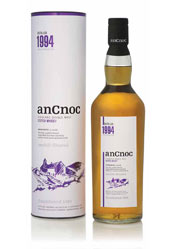
ancnoc 1994 vintageAnCnoc 1994 vintage
The colour is of this limited edition whisky golden with a hint of amber tone. The 1994 is the latest vintage release in the core range of AnCnoc, following on from a 1993 one. The nose is expressive and obviously sweet to begin with - initial honey and sultana notes are joined by a prominent cereal grain note plus something nutty (think of almonds) and grassy (imagine dry hay or straw). The palate reflects the characteristics of the nose well, although the cereals become more dominant with time. The finish is equally as grainy with an interesting mix of honey, vanilla and some dry wood spices (especially cinnamon). A good and easy drinking dram that offers something sweeter to the AnCnoc range.

ancnoc 1975 vintageAnCnoc 1975 vintage
The oldest AnCnoc single malt that is currently on the market. This whisky is a very different beast to any of the others that we tried. The colour is a dark golden amber and the nose is packed with interesting and intense aromas - vanilla, ginger, candied peel, cinnamon, cereals and orange oil. On the palate, this feels rich and full bodied with an intense woody spice (the cinnamon and ginger again) giving way and incorporating delicious notes of vanilla, cereal grains, coconut and orange. A hint of cocoa powder comes through right at the end. The intensity is fantastic but may be too much for some, so we tried it with a few drops of water - it remains very good with the orange note becoming even stronger and the spiciness dying slightly. The finish is dry and oaky. A great dram.

Distillery visit > Knockdhu

knockdhu distilleryThe final part of our recent tour took us to Knockdhu (pronounced nock-doo) distillery. The tour saw us visit a trilogy of whisky distilleries owned by Inver House Distillers, which is a subsidiary of the larger Thai Beverages company. Knockdhu was founded in 1893 by a group called Distillers Company Limited (DCL), who discovered natural springs in the surrounding hills, with production of whisky beginning in October 1894. The name of Knockdhu comes from the Gaelic language and translates as 'black hill'. The single malt whisky released from the distillery is known as AnCnoc (pronounced as a-nock) and this simply translates from gaelic as 'the hill'. Inver House took the decision to change the name of the single malts from Knockdhu in the 1990s, so that consumers would not confuse it with the Knockando distillery in Speyside.

The address of the distillery is given as Knock, near Huntly. As we discovered, addresses can sometimes be misleading! We skirted around the edge of the town of Huntly and headed off the main road in search of the village of Knock and therefore, the distillery. Over half an hour of driving passed as we drove down increasingly narrow roads in to the impending gloom of dusk and a developing fog. The two main questions being that "we must be there soon, mustn't we?" and "where the hell is this place?" The answer turned out to be that the village of Knock and its distillery are in the middle of nowhere, certainly not 'near' Huntly! The village has just a few houses plus the distillery and it sits at the bottom of an imposing black hill, which gives Knockdhu its name. The first impression was of a stunning location.

gordon bruce - knockdhu distillery managerOur tour was taken by Gordon Bruce, the Distillery Manager of Knockdhu (pictured, left). Gordon has worked his way up through the ranks, having started as a mash-man at Pulteney distillery back in 1986 and has come to Knockdhu via Balblair. He has held the position of Distillery Manager at 'The Knock', as he affectionately calls it, since 2006. We discover that he lives with his family in one of the few houses in the tiny village of Knock, is on call at the distillery 24/7 and that his two dogs frequent the distillery regularly - the comment being that "they are more photogenic than anyone else who works here!" Sadly, they were not there on the day of our visit.

ruined warehouse at knockdhu distilleryKnockdhu is not open to the public, so the chance to have a look around was to be a real treat. Despite this, Gordon commented that he has never turned any visitor away in his four years as Distillery Manager and has always found the time for himself or another member of staff to show them around. We begin with a short walk to the back of the distillery and pass two piles of rubble (pictured, left). Gordon explains that these are the remains of two of Knockdhu's five warehouses, which collapsed under the weight of heavy snow last winter. They managed to save most of the maturing whisky but he gets visibly emotional as he describes the loss of 18 casks - the roof caved in and the side walls were pulled down as a result, smashing the casks. This damage equated to £150,000 worth of whisky and included casks from 1989 to 2009.

The tour begins with a rare treat - a trip to see the distillery's old kiln and the chance to go inside it! Nowadays, most distilleries do not produce their own malted barley, so the malting floors and kilns are redundant. The kiln at a distillery is housed in the pagoda structure (Knockdhu's is pictured, below left) and these charismatic buildings give a distillery some photographic charm, but little else these days. Knockdhu's pagoda and kiln hasn't been used for around 40 years.

left - pagoda at knockdhu distillery, centre - inside the pagoda, right - view up in to pagoda ventWe firstly take a look at the large oven before moving upstairs, where Gordon opens a small doorway and beckons Matt, who happens to be first on the scene, inside. Faced with blackness and a fear of heights, Matt is reluctant - only for Gordon to reassure him with the words, "trust me, I'm a distiller!" before patting him on the back to coax him in! Once inside, we are standing on the mesh floor where the grains once sat with the kiln oven directly below us. The inside of the structure (pictured, above centre) is in some disrepair but plans are in place to renovate it. Gordon tells us that with a bit of work the kiln and its pagoda could function again, as everything including the triangular vent (viewed from directly below, above right) is operational. This was a totally unique experience and was put in to perspective when we were told that the room we had stood in could hold 25 tonnes of malted barley at a time.

mash tun at knockdhu distilleryAfter a brief visit to the milling room, which includes a Porteus mill from 1964 and a state-of-the-art grain filtering machine, we move on to the mash room. This room is is dominated by the huge circular stainless steel mash tun, where the malted barley is mixed with warm water to dissolve the soluble sugars from the grain. This water is added in three stages, with each stage at a higher temperature - this helps to ensure that the maximum amount of sugars are extracted from the barley. The three temperatures at Knockdhu are approximately 63°C, then 72°C and finally 82°C. This mash tun is new, having been installed in the summer of 2009, and boasts a striking domed copper top which replicates that of their previous mash tuns. We get to see the second water being added here.

washbacks at knockdhu distilleryNext up is the room where the fermentation takes place. This houses six large wooden tanks, known as washbacks. Here they take the sugary liquid from the mash tun (called wort) and add yeast to create alcohol. Each washback holds 21,500 litres of wort and to this they add 100 litres of liquid distillers yeast. The final product is called 'wash' and this has an alcohol level of around 8% ABV - the equivalent to a strong beer. It is interesting to hear that Gordon finds this the most interesting part of the whole whisky making process. The reason is that it is the one part that is hardest to control as you are relying on nature to do the job for you. In contrast everything else can be controlled by the workers - milling, mashing, distilling etc. We take the opportunity to try the 'wash', which is reminiscent of a malty, fruity ale.

It is only after Gordon's comments above on the fermentation and his emphasis on the skill of the distillery workers, that something becomes obviously apparent. This 'something' is confirmed in the still house - Knockdhu has no computers operating any stage of its whisky making process. Computers are now commonplace in many distilleries and control all aspects of production, so to see a distillery that is totally reliant on the traditional skills of its workers is unusual and refreshing. One of our group points this out and Gordon shows us the only 'computer' in the distillery ... a calculator!
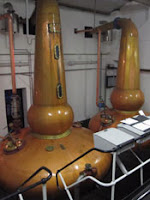
stills at knockdhu distilleryThe still room at Knockdhu is on the small side but feels much less cramped than those at Balblair and Pulteney. Here the stills (pictured, left) have more room and have flatter than normal bases, in comparison to many distilleries that have more bulbous ones. This forces the alcohol vapours to travel up tall narrow neck of the stills and helps to ultimately produce the light, fresh style of spirit that Knockdhu is well regarded for. The vapours then move along the horizontal lyne arms and out through the side wall of the still room in to a worm tub. Worm tubs are large tanks of cold water through which a spiraled copper pipe passes and this condenses the alcohol vapour back to a liquid spirit. Few distilleries still have worm tubs these days, preferring condensing units. Knockdhu is unique in the Scottish whisky industry as it is the only one to have both stills connected to the same worm tub. Sadly, it was dark by this point so we could not go up and see the coiled piping and water inside the worm tub properly.

The darkness and ever increasing fog prevented us from having a look in one of the remaining warehouses but Gordon then took us back to the offices, where he took us through a tasting of some of the whiskies bottled under the AnCnoc name. The brief tasting notes for these whiskies will follow shortly in a separate post. A massive thanks goes to Gordon for his time, insight, information and hospitality on our visit. We highly recommend a visit to this fascinating traditional whisky distillery and remember, you will never be turned away ...

Friday, November 19, 2010

Have just tried > The Balblair range

tasting glasses at balblairWe recently were lucky enough to visit the northern Highland distillery of Balblair, which is one of Scotland's oldest and most traditional. To read our visit notes - click here. We were even more lucky to be shown around by the Distillery Manager, John MacDonald, and the final part of our tour was a tasting of some Balblair whiskies. You will find our tasting notes below and a massive thanks goes to John for providing a wonderful experience. Only about 15% of the whisky made and maturing at the distillery is released as Balblair single malt. However, this amount is rising as Balblair becomes more widely recognised and the latest range continues to add to the numerous worldwide awards that it has recently won.

Interestingly, the core range is released as vintages, rather than the more common age statement in numbers of years - John tells us the reason for this is that "our whisky tells us when it's ready, not the other way round. Each vintage is hand picked from a selection of our finest casks, once its optimum maturation point is reached". The core range includes current vintages of 1965, 1978, 1989 and 2000. Not many distilleries or companies use this vintage system, so it was interesting to learn about the ethos behind it. Independent bottlings are occassionally available but stocks vary from year to year, with less now being released by the distillery to these bottlers.

Balblair new make spirit
Our tasting with John began with the rare opportunity to taste some new make spirit. This sample was distilled on the previous day and had an alcohol strength of 68% ABV. The colour is clear but has a hint of yellow to it and the nose is full of fresh green fruit - think of crisp apples especially. On the palate, the fruitiness is again prominent but the apple note is joined by a distinct lemony citrus tang. The spirit feels oily in the mouth and with time other notes battle through the high level of alcohol - vanilla, dried grass, honey and nuts. The finish is very fresh, tangy and hot with a chilli spiciness and the citrus from earlier particularly prominent.

balblair 2000 vintageBalblair 2000
This whisky is brand new, replacing the 1997 vintage in the core range and has been matured in second fill ex-bourbon casks. The colour is a pale gold and the nose is very fresh and very fruity. There are plenty of green pear and apple notes and these are backed up by vanilla, coconut and a whiff of mint (the coconut becomes more prominent with time). On the palate, this is again fresh with a lovely combination of flavours - peardrops, lemon zest, vanilla, honey, cereal grains and something reminiscent of icing sugar or sherbet. The finish is tangy but fairly short. This is an easy drinking dram that would be great in hot weather or as an aperitif.

balblair 1997 vintageBalblair 1997
As mentioned, this has now been replaced by the 2000 vintage above. However, we were still offered the chance to sample it for one last time! The whisky has a golden colour with a succulent nose that has aromas of dried fruits (sultanas and candied peel), vanilla, honey, spices (nutmeg and cinnamon) and hints of dried tropical fruit (pineapple and mango). On the palate, these elements combine with more citrus peel (think of orange marmalade), fresh stone fruits (peaches or apricots) and more sweet vanilla. The nutmeg spiciness from the nose comes through well. The finish is long with the sultana, vanilla and spice notes coming to the fore. Delicious stuff - goodbye old friend!

balblair 1989 vintageBalblair 1989
This whisky is from the second batch of the 1989 vintage that was bottled just a couple of months ago. The first batch was a multi award winning whisky, so we were very interested to try the new version. The colour is gold with a hint of amber and the nose is complex, soft and elegant. There are aromas of toffee, nuts, coconut, cereals plus an interesting ripe banana note. On the palate, this is creamy and mouth coating. It is soft and sumptuous with the notes from the nose present, in addition to some caramel, wood spice (cinnamon and nutmeg), pears and apples. The finish is long with the sweet elements (caramel and cereals especially) and the woody spices prominent.

balblair 1978 vintageBalblair 1978
Another recent addition to the range. This single malt was bottled as a 3,000 bottle limited edition in 2009 and replaced the 1975 vintage. The colour is dark gold with an amber tint. The nose is rich, deep and intense with plenty of dark dried fruits (raisins, sultanas and dates), toffee and spicy cinnamon bark. On the palate, this is rich and complex. There are many notes combining with those from the nose - vanilla, coconut, honey, stewed apples, hints of pepper and tropical fruits (especially mango and pineapple). The finish is long - it begins sweetly before becoming increasingly dry and spicy (especially the cinnamon), with some distinct cereal grains coming through.

> Please note that all of the single malts are bottled at 43% ABV, with the exception of the 1978 vintage which is 46% ABV.

Wednesday, November 17, 2010

Distillery visit > Balblair

balblair distilleryBalblair is located in the northern Highlands of Scotland in the picturesque village of Edderton, near to the town of Tain. It lies close to the shores of the Dornoch Firth, one of Scotland’s largest estuaries, with the Highlands rising behind it and the North Highland Inverness-Thurso railway track running next to it. The distillery is one of Scotland's oldest, having been founded by John Ross in 1790 - only Glenturret, Bowmore and Strathisla have been operating longer – although the current buildings were all built in 1893. Balblair is currently owned by Inver House Distillers, which is a subsidiary of the larger Thai Beverages group, and they have owned it since 1996.

Our tour of the Balblair distillery starts with the short drive from Tain to Edderton, a gorgeous little village that could adorn many a tin of shortbread, especially given the amazing display of vibrant autumn colours. The drive takes us passed the gates to Glenmorangie – Balblair’s larger and more illustrious immediate neighbour – before we turn off down a narrow lane to Balblair. The distillery is not currently open to the public, so the chance to look around felt like a privileged one.

john macdonald - distillery manager at balblairWe begin in the large open courtyard outside the Balblair offices, where we are greeted by John MacDonald (pictured, left). He has been the Distillery Manager at Balblair since 2006 and this follows 17 years service down the road at Glenmorangie, where he worked his way up through the ranks to the position of Assistant Manager. He puts his current success at Balblair, where his whiskies are winning many awards, down to the fact that he has done every job within a distillery – warehouseman, mill-man, mash-man, still-man and then senior management.

clach boirach standing stone at balblairJohn tells us a number of interesting geological and historical facts relating to the distillery and its local vicinity. Balblair means ‘battlefield’ in the ancient Pictish language and the area around Tain and Edderton was a Pict stronghold over 2,000 years ago. Clach Biorach, the local standing stone (pictured, left), was believed to be the centre of their community and stands close to the distillery. The stone has inspired the new packaging of Balblair’s whiskies, where they have used depictions of Pictish symbols and carvings on the bottle and box.

new visitor centre at balblair distilleryWe also learn that the water source for Balblair is the Allt Dearg spring, which is located high up in the hills about 4 and a half miles away from the distillery – this is one of the longest distances between any water source and a distillery in Scotland. The water runs using gravity via an open ditch from the source to the distillery and is used for all Balblair’s production and cooling needs. As it begins to rain, we move inside to the former floor malting room. This room (pictured, left) is earmarked to be the new visitor centre, which will open at Balblair next year. It has a distinctly ‘unfinished’ feel at the moment but the space is amazing and will make a memorable place for visitors to start their distillery tours in the future.

The mill room and adjoining malt storage area are next. The malted barley used for Balblair’s whiskies has a very low level of peat (approximately 1.5ppm – phenols per million) and they use several strains of barley. The mill is made by the now defunct Porteus company in 1981 (Porteus were a victim of their own success, making milling equipment that rarely broke or needed replacing - therefore no distilleries ever needed new ones!) The malt is stored in 10 huge silos, which hold 3 tonnes each. Therefore a total of 30 tonnes can be held and this fuels the distillery for 3 and a half weeks. This means that Balblair can maintain full operation during periods of bad winter weather when lorries cannot reach the distillery to deliver grain. At Balblair one tonne of barley produces 405 litres of spirit and it is on course to reach 1.36 million litres this year.

mash tun at balblair distilleryWe move on to the mashing room, which one of our tour party described as having a ‘Bond baddie evil hideout’ feel. This equates to lots of stainless steel equipment, piping across the ceiling and electrical panels with illuminated buttons! There is a stainless steel mash tun (pictured, above), where water is mixed with the milled barley (called grist) to extract the soluble sugars needed later in the whisky making process. This process is done at three different temperatures – 65°C, then 82°C and then 92°C. Balblair’s mashing time is one of the slowest in the industry at over six hours, as they use a rare natural drainage system. John explains that as a result the drained sugary liquid (known as wort) has a very low concentration of fatty compounds and this gives Balblair spirit its flavoursome and fruity characters.

fermentation washbacks at balblair distilleryBeyond the mash room is the room where the fermentation takes place. Balblair has six massive traditional wooden washbacks (pictured, left), with each one containing fermenting liquid at different timings in the process. Each washback can hold 21,500 litres of the sugary wort, to which 100 litres of liquid distiller's yeast is added. This then ferments for up to 62 hours, which is one of the longest times in the industry. This is so that the micro-flora bacteria held within wood of the washbacks have the maximum opportunity to add their character to the fermenting wash. Once finished, the wash has an alcoholic strength of 7.5% ABV and is like a strong ale - John let us taste the wash and it was very very fruity, reminiscent of a wheat beer.

stills at balblair distilleryNext, John leads us in to the still room. You quickly get an idea of how cramped it is going to be by hastily ducking under a slightly low copper pipe as you enter! They have one pair of stills at Balblair - one wash still and one spirit still (pictured, left). Unusually, there is also a third still at the far end. It is unorthodox to see an odd number of stills, as they tend to work in pairs. The story behind this third still is that it has not operated since 1969, when it was replaced, and it is too difficult to remove from the building! The stills have very large bulbous bases and short fat necks, which helps to create a heavier, more robust and oily style of spirit. Both lyne arms run outside through the still room wall, where the alcohol vapours are passed through condensers to become liquid again.

dunnage warehouses at balblair distilleryWith the weather closing in again, we are taken to shelter from the rain in one of Balblair's eight dunnage warehouses. The word 'dunnage' means to 'provide ventilation' but in this case refers to the traditional style of warehouse building that have stone walls, earth floors and a tiled roof (as pictured, left). These buildings provide the perfect environment, temperature and 'ventilation' for the maturing whisky. To further aid the maturation, the whisky casks are only stacked three high. Balblair's eight warehouses have a capacity of 26,000 casks of which around 15% are earmarked for single malt release. The rest is maturing for inclusion in a wide range of blends such as the popular Chivas Regal and Inver House's own Hankey Bannister range. John informs us that approximately 97% of the whisky is maturing in ex-bourbon casks, with the further 3% in ex-sherry casks.

Our tour concluded with a tasting hosted by John and then a large lunch. The reviews and tasting notes for this lovely range of whiskies can be found in a separate post - click here to view. We would like to take this opportunity to thank John for his insight in to the industry and his distillery, his information and his hospitality. If you are in that part of Scotland next year, then be sure to pay a visit and join one of their new tours. What you will find is a picturesque and traditional whisky distillery, that is hard to beat on both fronts.